
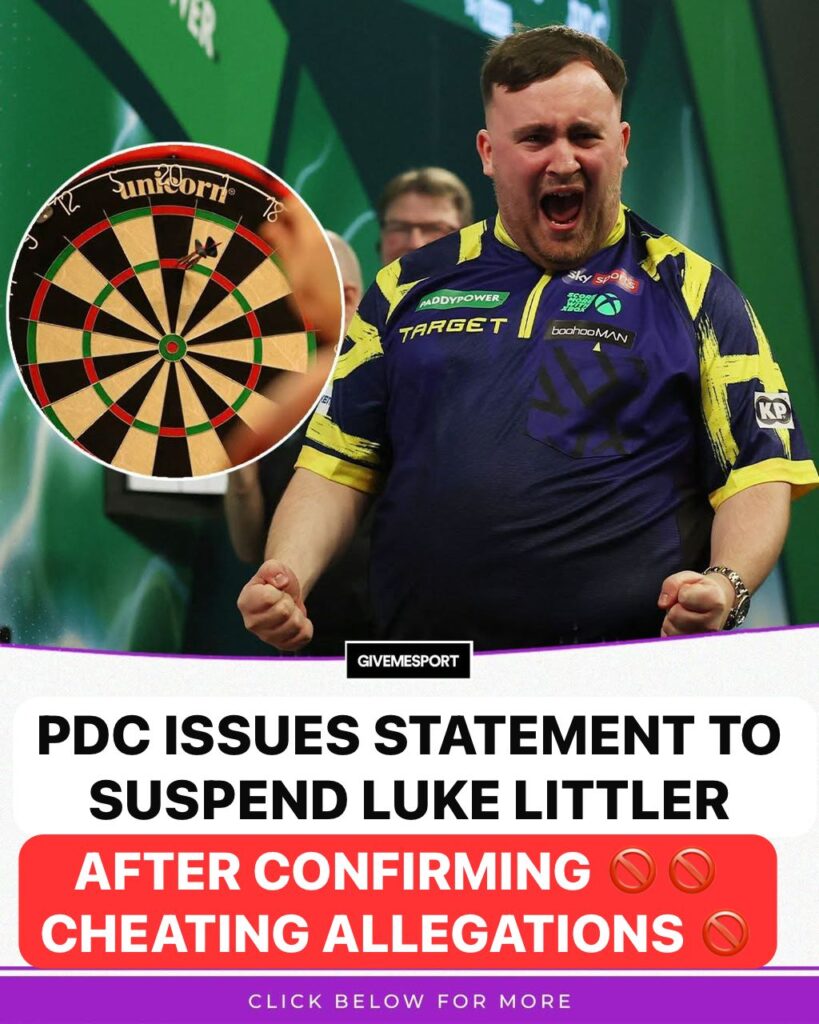
The darts world has been plunged into absolute chaos after explosive cheating claims linked to Luke Littler spread like wildfire across social media, forcing the Professional Darts Corporation (PDC) into urgent behind-the-scenes discussions and dividing fans across the globe.
What started as a handful of speculative posts quickly snowballed into one of the most volatile controversies the sport has seen in years. With no confirmed wrongdoing and no official punishment announced, the situation has nonetheless spiralled into a full-scale crisis — proving once again how fast narratives can form in the modern sports era.
Luke Littler, one of darts’ brightest young stars, suddenly found himself trending worldwide — not for a nine-dart finish or a match-winning double, but for allegations that many say have gone far beyond the evidence.
How the Storm Began
The controversy erupted after unverified claims began circulating online, alleging irregularities during recent matches involving Littler. Anonymous accounts pointed to slow-motion clips, screenshots, and heavily edited videos, suggesting “unusual patterns” and “questionable moments” during throws.
Within hours, the word “cheating” began appearing alongside Littler’s name.
Crucially, none of the clips were accompanied by official match reports, referee statements, or PDC confirmation. Yet that didn’t stop the claims from gaining traction. Influencers, fan pages, and reaction channels jumped in, each adding their own interpretation — and with every repost, the narrative grew more dramatic.
In the court of social media, suspicion moves faster than facts.
Fans Turn on Each Other
As the allegations spread, the darts community split sharply into two camps.
On one side were fans demanding answers, insisting the sport must investigate any claim that could threaten its integrity. They called for transparency, arguing that darts has worked too hard to build credibility to ignore even rumours.
On the other side were Littler’s supporters, who slammed the accusations as reckless, unfair, and damaging, particularly given the player’s age and spotless professional record.
“This is a witch hunt,” one fan wrote.
“You don’t destroy a career over TikTok edits.”
Comment sections quickly turned toxic. Long-time friendships in darts forums fractured. Some creators disabled comments entirely as abuse escalated.
Luke Littler’s Camp Breaks Silence — Carefully
As pressure mounted, attention turned to Littler himself.
While no lengthy public statement was immediately released, sources close to his camp made it clear that all allegations were firmly denied. Insiders described the claims as “baseless” and “built on misunderstanding of slow-motion footage and normal playing routines.”
Legal and professional advisers were reportedly consulted early, a move many interpreted as a sign of how seriously the situation was being taken — not as an admission of guilt, but as protection against reputational damage.
In modern sports scandals, silence is often strategy, not surrender.
PDC Forced Into Crisis Mode
With Littler’s name dominating darts headlines, the PDC found itself under growing pressure to respond.
Although no formal investigation was announced, multiple sources indicated that internal discussions were underway, focusing on:
- Match footage review protocols
- Umpire and referee reports
- Player protection against misinformation
- The impact of viral allegations on young athletes
A senior darts insider was quoted as saying:
“The PDC cannot ignore public noise, but it also cannot act on rumours alone.”
That balancing act — between maintaining integrity and avoiding knee-jerk reactions — has become one of the organization’s biggest challenges.
Rivals React — Carefully Chosen Words
Several professional players were asked about the situation during media appearances. Most chose their words with extreme caution.
A veteran player noted:
“Cheating is a serious accusation. If there’s evidence, it should be handled properly. If not, we need to be careful not to destroy someone.”
Others avoided naming Littler directly, instead stressing confidence in officiating systems and referees.
The message from within the professional ranks was clear: allegations must be proven, not popular.
The Role of Slow-Motion and Misinterpretation
One recurring theme in the debate has been the use of slow-motion footage.
Experts and analysts pointed out that when throws are slowed down dramatically, normal hand movements can appear suspicious. Grip adjustments, finger positioning, and release angles often look unnatural when examined frame by frame.
Several former officials stepped in to explain that:
- Equipment checks are routine
- Darts are inspected before matches
- Referees monitor play continuously
According to them, the likelihood of sustained cheating at elite level without detection is extremely low.
Yet once doubt enters public conversation, logic often struggles to catch up.
Mental Health Concerns Grow
Beyond the technical arguments, many voices raised concerns about mental health, especially for young players under intense scrutiny.
Luke Littler has risen fast — perhaps faster than anyone expected. With fame comes pressure, and with pressure comes vulnerability.
Sports psychologists warned that viral accusations, even false ones, can have long-lasting effects:
- Anxiety and stress
- Loss of confidence
- Distrust of fans and media
Supporters urged restraint, reminding the public that players are human first, athletes second.
Sponsors and Brand Watch Closely
Although no sponsors announced changes, industry watchers noted that controversies like this often place brands in “wait-and-see” mode.
Reputational noise, even without facts, can affect:
- Endorsement negotiations
- Media appearances
- Long-term brand alignment
For now, Littler’s commercial backing appears intact — but the situation highlights how fragile perception can be in elite sports.