
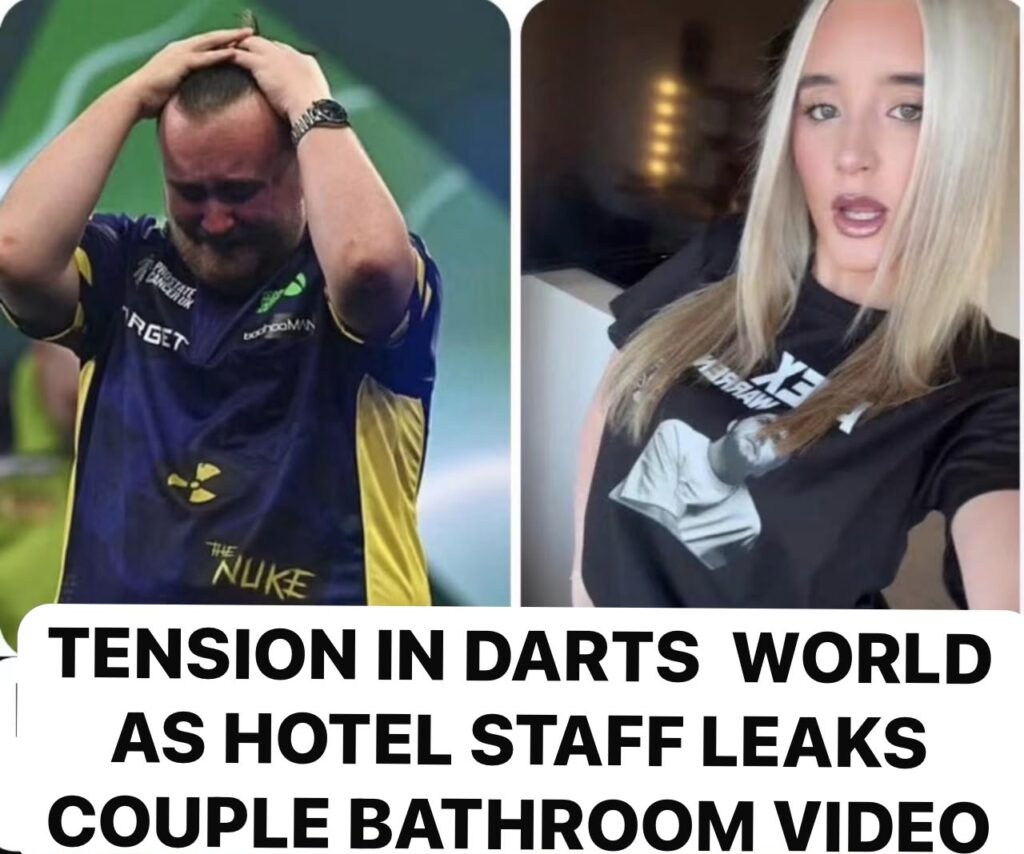
🚨TENSION In Darts World as Hotel Staff LEAKS Luke Littler’s Uncensored Bathroom Video To the entire dart community ….DETAILS⬇️
A developing controversy surrounding one of darts’ biggest stars has sparked questions about celebrity privacy, online rumours, and the responsibilities of those working in the hospitality industry.
The darts community is no stranger to controversy. From heated exchanges on stage to disputes involving spectators and intense rivalries between top players, professional darts regularly finds itself in the spotlight. But allegations involving someone’s private life raise an entirely different set of questions.
A headline circulating online claims that hotel staff leaked an uncensored bathroom video involving Luke Littler, prompting speculation about how such footage could have been obtained and shared.
At present, however, I could not verify this specific allegation through reliable news reporting. There is no confirmed evidence available here establishing that the alleged recording exists, that hotel staff leaked it, or that Littler or his representatives have issued a statement about such an incident.
Nevertheless, the allegation raises important issues worth examining: the protection of private spaces, the responsibilities of hotel employees, the dangers of viral misinformation, and the pressure placed on public figures whose personal lives attract enormous attention.
1. WHY THE ALLEGATION HAS ATTRACTED ATTENTION
Luke Littler has become one of the most recognisable names in professional darts. His rapid rise, major tournament performances, and growing public profile have made him a frequent subject of sports headlines and online discussions.
With that level of visibility comes an uncomfortable reality: stories about famous athletes can spread rapidly, even when the underlying claims have not been established.
An allegation involving a private bathroom recording is particularly serious because it concerns an area where people reasonably expect privacy. Unlike footage captured during a televised match or a public interview, a bathroom recording would raise questions about consent, access, and the circumstances in which the material was supposedly obtained.
However, it is important to distinguish between an allegation circulating online and an independently verified event. Repetition on social media does not establish that a video exists or that the person accused of leaking it is responsible.
Until credible evidence becomes available, the claim should not be treated as confirmed news.
2. THE HOTEL PRIVACY QUESTION
Hotels are expected to provide guests with a safe environment in which they can relax without fearing that private moments will be recorded or distributed.
Bathrooms and changing areas deserve especially strong protection. Guests should not have to worry that their private activities could become entertainment for strangers online.
If a hotel employee were ever found to have secretly recorded a guest or distributed an intimate recording without permission, the matter could raise serious questions about workplace conduct, guest safety, and potential legal consequences.
A proper investigation would need to establish what actually happened, whether a recording existed, how it was obtained, whether anyone had authorised its creation, and who, if anyone, distributed it.
These questions cannot responsibly be answered through speculation.
The identity of the hotel, the identity of any employee involved, and the circumstances of the alleged incident should not be guessed or invented.
3. WHY PUBLIC FIGURES STILL DESERVE PRIVACY
Fame often creates the impression that celebrities have surrendered their right to a private life. That assumption is mistaken.
Professional athletes agree to compete in public, participate in interviews, and appear in promotional campaigns. Those activities do not amount to consent to have their private moments recorded.
Littler’s achievements on the darts circuit may make him a familiar face to millions of fans, but that visibility does not eliminate his right to personal boundaries.
The same principle applies to actors, musicians, politicians, and ordinary people whose private information becomes the subject of public attention.
A person’s public profile should not be confused with permission to expose every aspect of their life.
4. HOW A VIRAL CLAIM CAN BECOME A MAJOR CONTROVERSY
In the modern digital environment, an unverified claim can travel across multiple platforms before journalists or the people involved have an opportunity to respond.
A post may be copied into a group chat, reposted with a more dramatic headline, and shared again by accounts seeking attention. With every repetition, the distinction between allegation and fact can become less visible.
Some posts may include unrelated footage, misleading captions, edited clips, or fabricated statements. Others may make claims about supposed evidence without providing any verifiable source.
That is why responsible reporting requires more than a viral post or a collection of comments.
For the allegation involving Littler, the central questions remain unanswered: Is there authentic evidence of a recording? Has the person concerned confirmed the incident? Has any reputable outlet independently verified the alleged leak?
Without answers, it would be premature to describe the story as an established scandal.
5. WHAT WOULD AN INVESTIGATION NEED TO ESTABLISH?
If a complaint about an unauthorised hotel recording were made, investigators would need to approach it methodically.
First, they would establish whether a recording exists and whether it depicts the person identified in the allegation. Digital material can be misrepresented, edited, or falsely attributed, so authentication would be essential.
Second, investigators would examine how the material was allegedly obtained. That could involve reviewing relevant security procedures, access records, and other lawful evidence.
Third, they would investigate whether the footage was distributed without permission and identify any available evidence concerning its circulation.
Finally, they would determine whether workplace rules, privacy protections, or applicable laws had been violated.
Any conclusions would need to follow the evidence rather than assumptions about a person’s occupation, access to a hotel room, or online reputation.
6. THE POTENTIAL CONSEQUENCES OF A GENUINE PRIVACY BREACH
A proven incident involving the unauthorised recording or distribution of private footage could have consequences beyond the immediate parties.
For an employer, the incident might require an internal investigation, a review of staff access policies, and measures to protect other guests.
For an employee found responsible, disciplinary action could follow, depending on the evidence, employment rules, and applicable law. Legal consequences would depend on the precise conduct and the jurisdiction involved.
For the person recorded, the consequences could include distress, reputational concerns, and the loss of control over deeply personal material.
These are potential consequences of a genuine privacy breach. They are not findings about the alleged incident involving Littler, which remains unverified.
7. HOW THE DARTS COMMUNITY MIGHT RESPOND
Professional darts has a passionate audience, and developments involving prominent players can generate intense online discussion.
If credible evidence of a serious privacy violation emerged, fans might reasonably expect the relevant parties to take the matter seriously. Questions could arise about player welfare, hotel security, and whether sporting organisations should provide additional guidance for competitors travelling to events.
However, there is currently no verified basis for claiming that darts players, tournament organisers, or the Professional Darts Corporation have reacted to this specific allegation.
It would be misleading to attribute statements to players or officials without reliable evidence that they made them.
The appropriate response is to wait for substantiated information rather than manufacture a community-wide reaction.
8. THE ROLE OF THE PROFESSIONAL DARTS CORPORATION
The Professional Darts Corporation plays a central role in professional darts, organising major competitions and promoting the sport internationally.
A genuine privacy incident involving a competitor could raise questions about the support available to players and the procedures used when travelling for tournaments.
Possible measures in a broader safeguarding review could include clearer reporting channels, guidance on handling private information, and cooperation with hotels to strengthen guest privacy.
Those are general considerations, not evidence that the PDC is investigating the alleged video or has announced any action concerning Littler.
Any claim about an official investigation, suspension, or disciplinary decision would require confirmation from a credible source.
9. WHY SHARING AN ALLEGED VIDEO COULD MAKE MATTERS WORSE
When private footage is alleged to have leaked, some internet users may be tempted to search for it or redistribute links.
That behaviour can intensify the harm associated with a genuine privacy breach. It can also expose viewers to fraudulent websites, malicious downloads, impersonation accounts, or fabricated material.
If a recording exists and was distributed without consent, repeatedly sharing it could extend its circulation long after the original incident.
The more responsible approach is not to seek out or redistribute purported private footage. Anyone who encounters material that may have been shared unlawfully can consider reporting it to the relevant platform rather than amplifying it.
This principle applies regardless of whether the person involved is a world-famous athlete or someone with no public profile.
10. THE DANGERS OF JUDGING BEFORE THE FACTS ARE KNOWN
Online controversy often creates pressure for an immediate verdict. People may demand that an employee be identified, that a hotel be named, or that a public figure respond before the basic facts have been established.
But an accusation is not proof.
There may be no authentic recording. The material may have been misidentified. A post may be deliberately misleading. Alternatively, an actual privacy breach could have occurred and require a serious response.
Without verified evidence, none of these possibilities should be presented as the established explanation.
Fair reporting protects the public’s ability to understand what happened without exposing innocent people to unsupported accusations.
11. WHAT FANS SHOULD WATCH FOR NEXT
Anyone following this story should prioritise information from credible sports journalists, established news organisations, official statements, and other sources that can demonstrate how their claims were verified.
The most useful developments would include confirmation of whether an incident occurred, a reliable account of how the alleged recording was obtained, and any verified statement from the parties involved.
If authorities or an organisation were to announce an investigation, that announcement would provide a stronger factual basis for further reporting. Even then, the existence of an investigation would not automatically establish that the allegation was true.
Until such information emerges, readers should be cautious about posts claiming to reveal the video’s contents, naming supposed suspects, or announcing consequences that have not been confirmed.
12. A BROADER LESSON FOR SPORT AND CELEBRITY CULTURE
The allegation highlights a wider challenge facing public figures in an era when phones, social platforms, and viral content can bring private information into public discussion almost instantly.
Athletes need to be able to travel, stay in hotels, and conduct their personal lives without assuming that every private moment could become online content.
Hotels and other hospitality businesses have an interest in maintaining guest trust. Sports organisations have an interest in protecting competitors’ welfare. Social media users also have a role in refusing to reward unverified claims with automatic attention.
These responsibilities do not disappear when the person involved is controversial, highly successful, or frequently discussed online.
Privacy should not depend on whether the public likes the individual concerned.
CONCLUSION: QUESTIONS REMAIN UNANSWERED
The claim that hotel staff leaked an uncensored bathroom video involving Luke Littler is a serious allegation, but it has not been verified by the reliable reporting available for this article.
At this stage, there is no confirmed basis to state that a leak occurred, identify a responsible employee, describe the alleged footage, or report an official response.
What can be said is that unauthorised recordings in private spaces would raise serious concerns if proven. Such an incident would deserve a careful investigation, respect for the affected person’s privacy, and reporting grounded in evidence.
For now, the key question is not how sensational the headline sounds. It is whether credible evidence supports the claim.
The bottom line: Until reliable confirmation becomes available, the alleged Luke Littler bathroom-video leak should be treated as an unverified claim—not an established scandal.
Readers should avoid spreading purported private footage and wait for trustworthy information before drawing conclusions.