
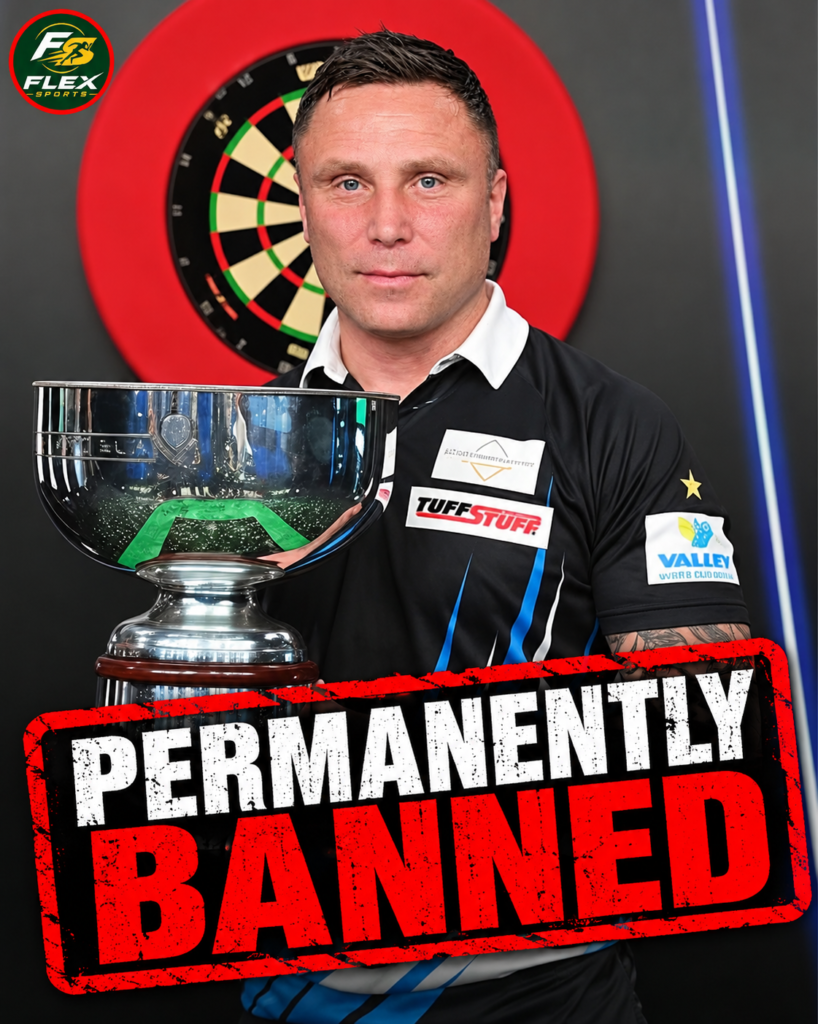
CHAOS IN DARTS: Gerwyn Price Faces MASSIVE CONTROVERSY After Shocking Scoring Incident at Grand Slam of Darts – Full Details
The darts world has been thrown into heated debate following a controversial incident involving former world champion Gerwyn Price at the 2026 Grand Slam of Darts. A disputed checkout against Sebastian Bialecki has raised serious questions about officiating, fair play and the reliability of scoring procedures at the highest level of professional darts.
The world of professional darts has witnessed another dramatic moment, with Gerwyn Price finding himself at the centre of an unexpected controversy during the 2026 Grand Slam of Darts in Wolverhampton.
Price, popularly known as ‘The Iceman’, was involved in an unusual incident during his Group E encounter against Poland’s Sebastian Bialecki. What initially appeared to be a routine leg victory quickly became one of the most discussed moments of the tournament after viewers noticed that the Welshman had actually exceeded the score required to finish the leg.
The incident immediately attracted attention from darts supporters, commentators and sporting observers. Questions were raised about how such an error could happen at a major professional tournament and whether the result should have been allowed to stand.
However, despite sensational claims circulating online, there is no verified announcement that Price has been permanently banned by the Professional Darts Corporation (PDC), nor is there evidence that he deliberately cheated.
Instead, the controversy centred on an admitted referee scoring mistake.
And while the incident created plenty of discussion, Price’s tournament ultimately ended in remarkable fashion, with the Welshman lifting his fourth Grand Slam of Darts trophy.
HOW THE CONTROVERSY STARTED
The incident happened during Price’s Group E match against Sebastian Bialecki at the 2026 Grand Slam of Darts.
The match was important for both players, as they were competing for a place in the knockout stages of the tournament.
Price entered the contest as one of the experienced favourites. Having already won the Grand Slam three times, he understood the importance of avoiding unnecessary mistakes in a competition where every leg could influence qualification.
The Welshman eventually secured a 5-2 victory, but one particular leg became the subject of widespread discussion.
During the fourth leg, Price was attempting to finish a checkout of 135.
He began by hitting treble 19, which should have reduced his remaining score to 78.
However, when he asked the referee how much he had left, he was incorrectly informed that he had 88 remaining.
Trusting the information supplied by the official, Price proceeded to throw treble 16 and double 20.
He was subsequently awarded the leg.
The problem was that his darts had added up to 145, meaning he had exceeded the 135 required to finish.
Under normal circumstances, this would have constituted a bust, and the leg should have continued.
The unusual sequence was not immediately identified by the players or officials on stage.
It was only after the match that the scoring error became a major talking point.
DID GERWYN PRICE DELIBERATELY CHEAT?
This was arguably the biggest question to emerge from the controversy.
Darts supporters began discussing whether Price had knowingly benefited from the incorrect checkout and whether he should have done anything differently.
However, the available evidence does not establish deliberate cheating.
Price explained that he had asked the referee for his remaining score and followed the information he was given.
Speaking after the match, he indicated that he had not realised the calculation was wrong until shortly before his press conference.
His explanation was that he had simply followed the referee’s instruction.
He also admitted that he was glad he had not known about the mistake during the match because it might have affected his concentration.
That explanation is important because there is a significant difference between deliberately manipulating a sporting result and benefiting from an official’s mistake without knowing that an error has occurred.
There has been no verified finding that Price intentionally attempted to deceive his opponent or the tournament officials.
THE PDC RESPONDS TO THE INCIDENT
Following the controversy, the Professional Darts Corporation acknowledged that a rare scoring error had occurred.
The organisation explained that the incident involved the incorrect score being announced by the referee.
It also referred to the relevant Darts Regulation Authority regulations governing arithmetic errors during matches.
Under the applicable rules, an incorrect leg result can stand if the mistake is not corrected before the beginning of the next leg.
This meant that the fourth-leg decision could not simply be reversed after the match had continued.
The rule exists to provide certainty and prevent completed legs from being repeatedly reopened after play has moved forward.
Although the situation was unusual, the regulations provided a basis for maintaining the result.
The PDC’s explanation did not amount to an accusation against Price. Rather, it acknowledged an officiating error and explained why the result stood.
WHY FANS WERE SO ANGRY
The reaction from supporters was understandable.
Professional darts is a sport where precision matters enormously.
Players spend years developing their mathematical awareness, accuracy, concentration and ability to perform under pressure.
At major competitions, the difference between winning and losing can come down to a single dart.
Consequently, an error involving a checkout calculation can create serious questions about the fairness of a match.
Some supporters questioned why the referee’s calculation was not immediately challenged.
Others wondered whether electronic scoring technology could help reduce the possibility of similar incidents happening in the future.
There were also discussions about whether the opponent should receive additional protection when an incorrect score is announced.
The situation was particularly sensitive because the Grand Slam of Darts is one of the most prestigious competitions on the professional calendar.
With significant prize money and ranking points at stake, supporters naturally expect the highest standards of officiating.
Nevertheless, the controversy should be understood in its proper context: the PDC acknowledged a referee’s error, and the rules determined that the leg would stand.
WHAT THE RULES ACTUALLY SAY
The Darts Regulation Authority has specific provisions dealing with arithmetic errors.
Rule 6.4.6 explains that errors in arithmetic stand as displayed on the scoreboard unless corrected before the next throw of the player whose score is incorrect.
Rule 6.4.7 further explains that if an incorrect score results in a leg victory, that result stands unless the error is corrected before the beginning of the next leg.
These provisions are important because they establish a clear point at which a leg becomes final.
In Price’s case, the incorrect checkout had already been accepted and the match had progressed.
Consequently, the incident could not simply be reversed after the fact.
Although supporters might disagree with the outcome, the rules provided the framework for resolving the situation.
PRICE’S RESPONSE: ‘I’M GLAD I DIDN’T KNOW’
Price’s post-match comments added another dimension to the discussion.
The Welshman explained that he had no idea about the scoring mistake while playing.
He described asking the referee what remained after his first dart and being told 88.
He then followed the checkout route based on that information.
Price also indicated that discovering the mistake during the match would probably have affected his concentration.
His comments suggested that he was surprised by the controversy rather than deliberately attempting to benefit from it.
For a player competing at the highest level, maintaining concentration is extremely important.
A player who begins questioning every decision while still competing risks losing focus on the match itself.
Price’s explanation therefore became an important part of the conversation surrounding the incident.
A FOURTH GRAND SLAM TITLE FOR THE ICEMAN
While the scoring controversy attracted enormous attention, Price’s overall tournament performance deserves recognition.
The Welshman entered the competition with an impressive Grand Slam history.
He had previously lifted the trophy in 2018, 2019 and 2021.
His fourth title would make him one of the most successful players in the history of the competition.
After navigating the tournament, Price eventually reached the final against Dutch star Gian van Veen.
The final took place in Wolverhampton on November 22, 2026.
Price produced an impressive performance to secure a 16-11 victory.
His success ended a four-year wait for another Grand Slam crown and earned him the £200,000 top prize.
It was a significant achievement for a player who had experienced several disappointing major finals during the year.
His victory also moved him up to third position in the PDC world rankings.
The result demonstrated that, despite the surrounding controversy, Price remained capable of delivering outstanding performances on the biggest stage.
COULD A PLAYER BE BANNED FOR A SCORING INCIDENT?
One of the most important issues to clarify is the difference between a scoring mistake and a disciplinary offence.
Professional darts has regulations governing player conduct, integrity, betting, match manipulation and other breaches.
A player found guilty of serious misconduct can face disciplinary action, including suspension.
However, a referee announcing the wrong score does not automatically mean that the player who benefits from the mistake has committed an offence.
Any allegation of deliberate cheating would require evidence and an appropriate investigation.
In Price’s case, the available reports do not establish such a finding.
There is also no verified PDC announcement confirming a permanent ban.
Therefore, claims that the Welshman has been permanently removed from professional darts should not be treated as established news.
WHAT THIS INCIDENT MEANS FOR PROFESSIONAL DARTS
Although the controversy did not result in a confirmed disciplinary punishment for Price, it has highlighted an important issue for the sport.
Professional darts increasingly operates under enormous public attention.
Matches are broadcast internationally, millions of viewers follow major competitions, and the smallest mistakes can become viral moments.
The sport therefore needs reliable systems that protect the integrity of competition.
One possible improvement would involve additional verification procedures for important checkout calculations.
Another would be reviewing how referees communicate remaining scores to players.
The incident also demonstrates the importance of maintaining accurate electronic scoreboards and ensuring that officials have adequate support.
However, technology must be introduced carefully.
Darts remains a sport that depends heavily on human officiating, and any changes must preserve the flow and character of the game.
The goal should be to reduce avoidable errors without unnecessarily complicating the competition.
THE BIGGER PICTURE: PRICE REMAINS A MAJOR FORCE
Gerwyn Price’s career has been filled with memorable achievements, intense rivalries and moments of controversy.
The former rugby player transformed himself into one of the most recognisable figures in professional darts.
His aggressive competitive style, powerful scoring and emotional celebrations have made him a popular subject of discussion among fans.
He became world champion in 2021 and has repeatedly demonstrated his ability to compete against the best players in the world.
His four Grand Slam titles are further evidence of his remarkable consistency at the event.
The 2026 tournament added another chapter to his career.
Although the scoring incident created an uncomfortable discussion, his eventual triumph demonstrated his ability to overcome the pressure of a major competition.
For his supporters, the fourth Grand Slam title was a moment of celebration.
For his critics, the controversial checkout remained an opportunity to question the officiating standards.
Either way, the incident became one of the memorable talking points of the tournament.
FINAL VERDICT
The controversy involving Gerwyn Price at the 2026 Grand Slam of Darts has generated considerable discussion across the darts community.
A referee’s incorrect calculation during his match against Sebastian Bialecki resulted in a leg being awarded after Price had actually exceeded the required checkout score.
The PDC acknowledged the mistake, but the applicable DRA regulations meant that the leg result stood.
Importantly, there is no verified evidence establishing that Price deliberately cheated, and no confirmed announcement that he has been permanently banned by the PDC.
Instead, the biggest lesson from the incident concerns the importance of accurate officiating and reliable scoring procedures in professional darts.
Price subsequently went on to defeat Gian van Veen 16-11 in the final, securing his fourth Grand Slam of Darts championship.
One thing is certain: the 2026 Grand Slam will be remembered not only for Price’s incredible return to the winner’s circle but also for the unusual scoring controversy that sparked debate throughout the competition.