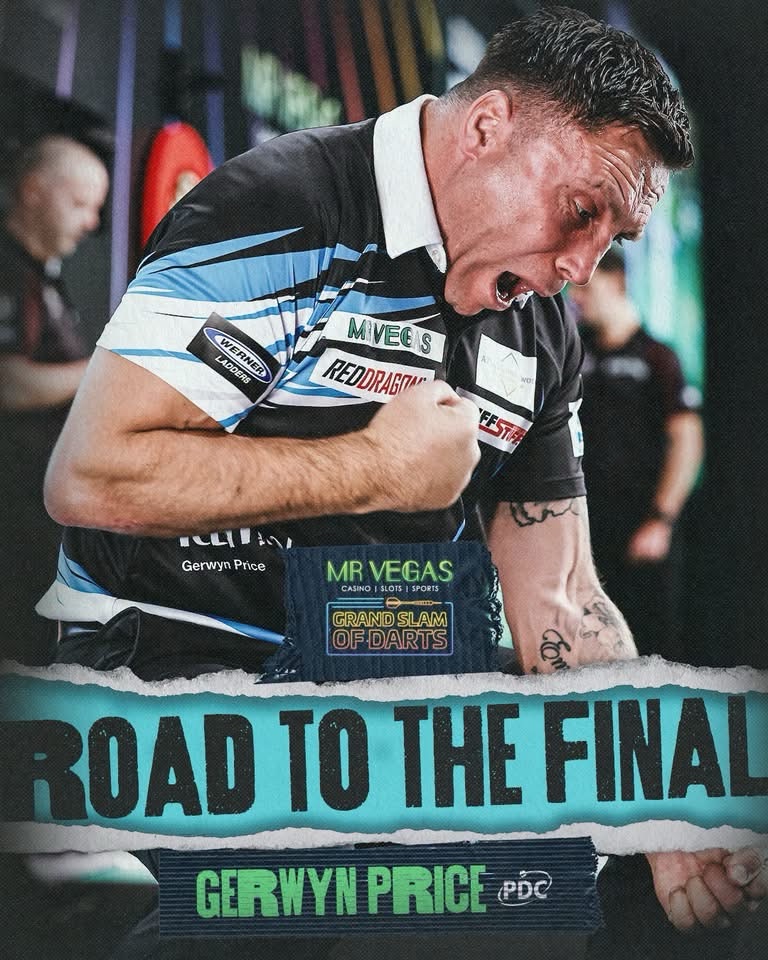
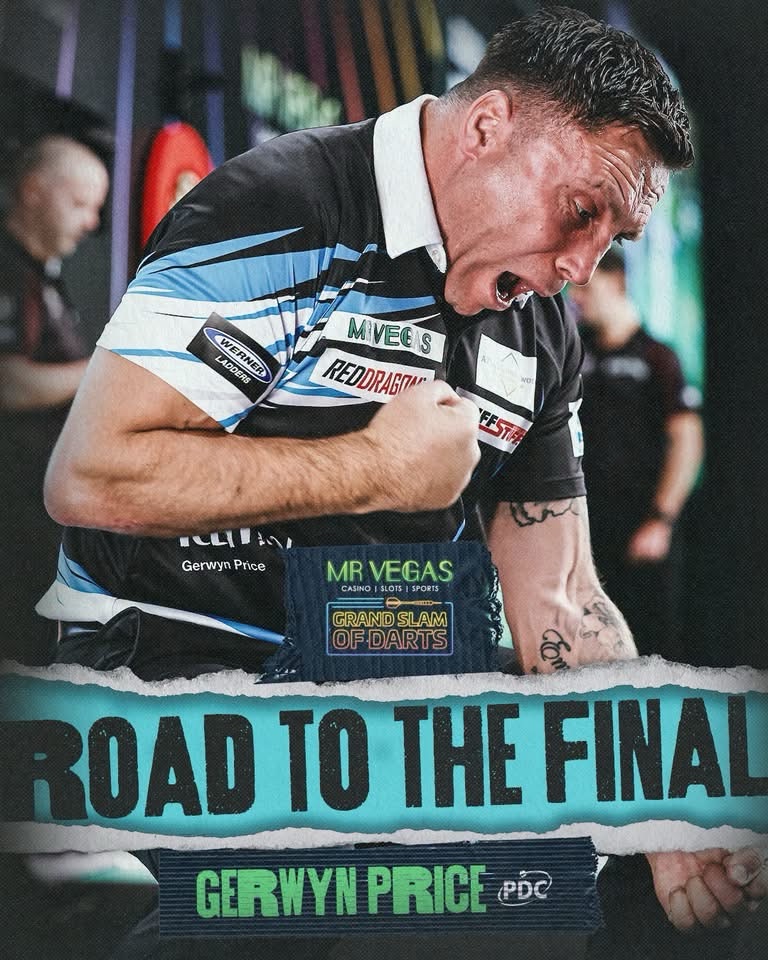
JUST IN: Darts World Rocked by Gerwyn Price Controversy as PDC Addresses Extraordinary Championship Scoring Incident – Full Details
The professional darts world has been caught up in a major debate following an extraordinary incident involving Welsh darts superstar Gerwyn Price at the 2026 Grand Slam of Darts.
The former world champion found himself at the centre of controversy after an unusual scoring error during his match against Poland’s Sebastian Bialecki raised questions about officiating, fairness and the importance of accuracy in professional darts.
While claims circulating online have suggested that Price was suspended for allegedly using magnetic darts, there is currently no verified evidence supporting that allegation. No official PDC announcement confirms a suspension or a cheating investigation involving magnetic equipment.
Instead, the actual controversy involved a referee providing Price with an incorrect remaining score during a crucial leg of his match.
The incident quickly attracted attention from darts supporters, with many questioning how such an error could happen during a major televised competition.
But what exactly happened, why did the PDC allow the result to stand, and how did Price respond?
Here is everything you need to know.
A Championship Moment That Sparked Debate
The 2026 Mr Vegas Grand Slam of Darts was expected to provide another exciting opportunity for some of the world’s biggest darts stars to demonstrate their abilities.
Among the competitors was Gerwyn Price, one of the most recognisable and competitive players in professional darts.
Known affectionately as The Iceman, Price entered the competition with considerable expectations. The Welshman had previously won the Grand Slam of Darts in 2018, 2019 and 2021, making him one of the tournament’s most successful competitors.
However, his match against Sebastian Bialecki produced an unexpected moment that would become one of the biggest talking points of the competition.
Price was leading the match when he approached a crucial checkout opportunity.
What initially appeared to be an ordinary scoring sequence quickly developed into an unusual situation involving the referee, the scoreboard and the rules governing professional darts.
The incident would eventually lead to an official response from the Professional Darts Corporation.
What Actually Happened Between Gerwyn Price and Sebastian Bialecki?
The controversy occurred during the fourth leg of Price’s Group E encounter against Sebastian Bialecki.
At that point, Price was leading 2-1 and needed 135 points to complete the leg.
He began his visit by hitting treble 19, scoring 57 points.
After the first dart, his remaining score should have been 78.
However, Price asked the referee, Charlie Corstorphine, how many points he had remaining.
The referee incorrectly informed him that he had 88 points left.
Trusting the information provided by the official, Price continued his visit.
He subsequently hit treble 16 and double 20, scoring another 88 points.
The referee then declared the leg complete.
But there was a problem.
Price had actually scored 145 points against a required total of 135.
Under the normal rules of darts, exceeding the required checkout score means the player has gone bust.
Consequently, the checkout should not have counted.
The situation was particularly unusual because Price had relied on the referee’s incorrect calculation when selecting his final two darts.
Neither the player nor the officials immediately recognised the mistake.
By the time the error became apparent, the next stage of the match had already begun.
PDC Breaks Silence on the Controversial Incident
Following the incident, the Professional Darts Corporation acknowledged that an unusual scoring error had occurred.
The organisation explained that the referee had made an arithmetic mistake during the fourth leg of the match.
However, the PDC also clarified why the result could not simply be reversed.
According to the explanation provided to BBC Sport, the relevant Darts Regulation Authority rules meant that the leg result had to stand because the mistake had not been corrected before the next leg began.
This was an important distinction.
Although Price had technically exceeded the required checkout score, the regulations governing the competition determined that the announced result would remain valid.
The situation therefore became a debate about the difference between what should have happened during the leg and what the official regulations permitted after the error had been allowed to stand.
The PDC’s explanation did not accuse Price of cheating or suggest that he had deliberately manipulated the result.
Instead, the organisation identified the incident as a rare officiating error.
Did Gerwyn Price Know About the Scoring Mistake?
One of the most interesting aspects of the controversy was Price’s reaction after learning what had happened.
The Welshman explained that he had not realised there was an error when he completed the leg.
According to his post-match comments, he had simply asked the referee for his remaining score and followed the information he was given.
Price explained that he was only made aware of the mistake shortly before entering his post-match press conference.
He also admitted that he was glad he had not known about the incident while the match was still ongoing.
Knowing that an error had occurred could potentially have affected his concentration and mental approach to the remainder of the match.
His comments added another dimension to the debate.
For some supporters, the situation demonstrated that Price had simply trusted the match official and acted on the information available to him.
Others argued that players should remain aware of their own scores, particularly during important moments in major competitions.
Nevertheless, the available evidence does not establish that Price deliberately attempted to gain an unfair advantage.
Why the Incident Created Such a Huge Debate
Professional darts is a sport where accuracy matters enormously.
A single dart can determine the outcome of a leg, a match or even an entire championship.
Players spend years developing their ability to calculate scores, identify checkout combinations and maintain concentration under pressure.
Referees also play a critical role.
They are responsible for announcing scores, confirming checkouts and ensuring that matches are conducted according to the regulations.
When an incorrect score is announced, the consequences can be significant.
The Price incident demonstrated just how much influence a seemingly small arithmetic mistake can have during a professional match.
The controversy also raised questions about whether additional scoring verification systems could help prevent similar situations.
With technology becoming increasingly important in professional sports, some supporters have argued that electronic verification should play a greater role in high-pressure matches.
Others believe that the existing system works effectively and that occasional human errors should be handled through the established regulations.
Regardless of the differing opinions, the incident placed officiating standards firmly in the spotlight.
What Do the Darts Rules Say?
The relevant regulations are contained in section 6.4 of the Darts Regulation Authority rulebook.
Two provisions were particularly important.
Rule 6.4.6 addresses errors in arithmetic and explains that announced scores stand unless corrected within the specified period.
Rule 6.4.7 specifically addresses situations where an incorrect score results in a leg being won.
Under that provision, the result stands unless the error is corrected before the beginning of the next leg.
This was the provision that determined the outcome of the Price incident.
Although the checkout was mathematically incorrect, the timing of the discovery meant that the result could not be overturned under the applicable rule.
The regulation exists to provide certainty during competition and prevent matches from being repeatedly reopened after subsequent play has commenced.
However, incidents like this inevitably generate discussion about whether the regulations provide sufficient protection for both competitors.
Sebastian Bialecki and the Other Side of the Story
While much of the attention focused on Gerwyn Price, Sebastian Bialecki was also directly affected by the incident.
The Polish player was competing against one of the biggest names in professional darts and would have wanted the match to be decided entirely through the players’ performances.
The controversial fourth leg represented an unusual moment in the encounter.
Had the checkout been correctly identified as a bust, the leg would have continued, potentially creating another opportunity for Bialecki.
Instead, Price was awarded the leg.
Nevertheless, the official result remained unchanged, and Price eventually secured a 5-2 victory.
The incident also highlighted the difficult position competitors can find themselves in when officiating mistakes occur.
Players are expected to respect the decisions of match officials, even when those decisions later prove to be incorrect.
For Bialecki, the experience was undoubtedly an unusual part of an important tournament encounter.
Price Continues His Championship Campaign
Despite the controversy, Price continued his campaign at the 2026 Grand Slam of Darts.
His victory over Bialecki helped him progress to the knockout stages, where he faced increasingly difficult opposition.
The Welshman demonstrated that he remained a serious contender for the championship.
He subsequently defeated Ryan Searle and Niko Springer to secure his place in the semi-finals.
His next challenge came against Dutch player Kevin Doets.
Price produced another impressive performance, winning 16-13 to book his place in the tournament final.
The victory was particularly important because it brought him within one match of another major Grand Slam title.
Gerwyn Price Wins the 2026 Grand Slam of Darts
In a remarkable conclusion to the tournament, Gerwyn Price went on to defeat Gian van Veen 16-11 in the final on November 22, 2026.
The victory secured his fourth Grand Slam of Darts championship.
It was a significant achievement for the Welshman, who had previously lifted the trophy in 2018, 2019 and 2021.
Price produced an outstanding finishing performance in the final, recording five ton-plus checkouts.
His victory also ended a five-year wait for another televised ranking title.
The championship success demonstrated his ability to deliver under pressure, despite the attention surrounding the earlier scoring controversy.
For Price, the victory was an opportunity to return to the top of the sport and silence some of the criticism that had followed him throughout the season.
The Magnetic Darts Allegation: What Is Actually Known?
Another claim that has circulated alongside the controversy concerns the alleged use of magnetic darts.
The allegation suggests that Price was suspended by the PDC after supposedly using magnetic equipment during a championship.
However, it is important to distinguish between an online allegation and an officially established disciplinary matter.
There is currently no verified announcement confirming that Gerwyn Price used magnetic darts, that an investigation into such equipment took place, or that the PDC suspended him for cheating.
The documented controversy involved an incorrect score announced by a referee.
These are two entirely different matters.
Professional darts competitions operate under equipment regulations, and allegations involving prohibited equipment would require evidence and an appropriate disciplinary process.
Until an official statement or credible report establishes otherwise, claims of magnetic-dart cheating should not be presented as confirmed news.
Could This Incident Affect the Future of Professional Darts?
The controversy has highlighted an important issue that professional darts organisers may wish to consider.
As the sport continues to grow internationally, maintaining confidence in officiating becomes increasingly important.
Major tournaments attract millions of viewers, significant sponsorship investments and some of the world’s most talented players.
Supporters expect matches to be decided through skill, concentration and performance.
An avoidable scoring mistake can undermine that confidence, even when the rules provide a clear explanation for why the result must stand.
There are several possible improvements that could help reduce similar incidents.
First, additional electronic score verification could help referees confirm complicated scoring situations.
Second, officials could receive more frequent training to improve accuracy during high-pressure matches.
Third, competition organisers could consider whether certain scoring decisions should receive additional verification before a leg is officially completed.
These measures would not necessarily eliminate every mistake, but they could help protect the integrity of future competitions.
Fans Remain Divided Over the Controversy
The incident generated considerable discussion among darts supporters.
Some fans defended Price, arguing that he had simply followed the referee’s instructions and should not be blamed for an official’s mistake.
Others questioned whether players should take greater responsibility for keeping track of their own scores.
There were also supporters who focused their criticism on the officiating system, arguing that mistakes of this nature should be prevented at major tournaments.
The disagreement reflects the passion surrounding professional darts.
For many fans, the sport is about more than throwing darts at a board. It is about fairness, discipline, concentration and the confidence that every competitor is playing under the same conditions.
When an unusual incident occurs, supporters naturally want answers.
The PDC’s explanation provided clarification about the regulations, although it may not completely end the discussion.
Final Thoughts
The Gerwyn Price controversy at the 2026 Grand Slam of Darts will undoubtedly remain an unusual moment in the tournament’s history.
A referee’s scoring mistake resulted in Price being awarded a leg after an incorrect checkout, creating a debate about officiating and the application of professional darts regulations.
However, the available evidence does not support claims that Price was suspended for using magnetic darts or deliberately cheating.
The PDC acknowledged the scoring error, explained the relevant regulations and allowed the result to stand.
Price subsequently continued his campaign and secured his fourth Grand Slam of Darts title with a 16-11 victory over Gian van Veen.
While the controversy may continue to generate conversations among supporters, the distinction between an officiating mistake and deliberate cheating remains essential.
For now, the biggest confirmed story is not a magnetic-dart suspension but an extraordinary scoring incident followed by a championship-winning performance from The Iceman.