
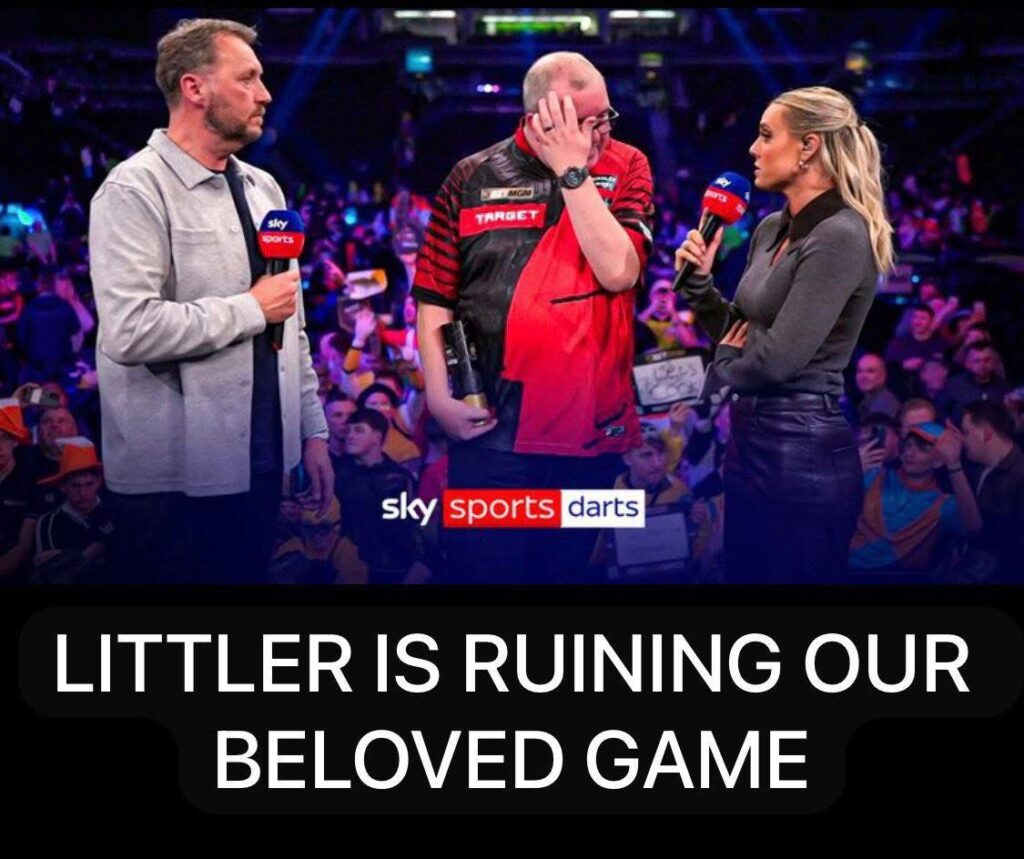
The darts world has been thrown into chaos after Stephen Bunting allegedly made a stunning accusation against Luke Littler, claiming that the teenage superstar may have crossed the line during a controversial encounter.
In a dramatic development that has sent fans into a frenzy, Bunting is said to have demanded that the Professional Darts Corporation launch an immediate investigation into Littler.
And according to the explosive claims circulating online, the situation could go even further.
Bunting has allegedly threatened to walk away from professional darts altogether if the PDC refuses to investigate the matter properly.
The alleged statement has triggered fierce debate among fans, players and pundits, with some demanding answers while others insist that Littler deserves the presumption of innocence until any evidence is established.
One thing is certain: the fictional controversy has created one of the biggest storylines darts has seen in years.
THE ALLEGED EXPLOSION
According to the fictional scenario surrounding the controversy, tensions had been building behind the scenes for several weeks.
Bunting, known affectionately by fans as “The Bullet,” had reportedly become increasingly frustrated by what he believed were irregularities surrounding Littler’s conduct during competition.
The exact nature of the alleged incident remains deliberately unclear in this fictional storyline.
However, Bunting is said to have raised concerns about certain moments during a high-pressure match, claiming that something did not look right to him.
Rather than keeping his concerns private, the fictional Bunting allegedly decided that enough was enough.
And that is where the situation exploded.
Sources within this fictional storyline claim that Bunting confronted officials and demanded that the PDC examine footage, match procedures and every available piece of evidence.
The demand allegedly left officials stunned.
The situation reportedly became even more intense when Bunting allegedly declared that he would not simply accept a dismissal of his concerns.
He wanted an investigation.
He wanted answers.
And, according to the fictional story, he wanted the PDC to take disciplinary action if wrongdoing was discovered.
“THIS CAN’T BE IGNORED”
The fictional Bunting is alleged to have delivered an uncompromising message:
“This cannot be ignored.”
That sentence quickly became the centre of the controversy.
Bunting allegedly argued that professional darts depends on trust.
Players compete under intense pressure, thousands of fans watch from the stands and millions more follow tournaments around the world.
According to the fictional accusation, Bunting believes that the integrity of the sport must always come before individual reputations.
That is what supposedly pushed him to make such a dramatic demand.
The allegation was not simply about winning or losing.
It was allegedly about whether players could trust the competitive environment.
And that distinction changed the entire tone of the fictional controversy.
WHY LUKE LITTLER IS AT THE CENTRE OF THE STORM
Luke Littler has become one of the biggest names in darts at an extraordinary speed.
The young Englishman has repeatedly attracted enormous attention because of his performances, consistency and ability to perform under pressure.
His rise has also created an inevitable level of scrutiny.
Every big performance brings praise.
Every unusual moment attracts discussion.
Every defeat generates analysis.
And every controversy becomes headline news.
In reality, Littler’s 2026 season has already included major victories and high-profile performances. He successfully defended his World Championship title in January, and his performances have continued to attract global attention. (Wikipedia)
That extraordinary profile makes him the perfect centrepiece for a fictional darts scandal.
But fame also comes with a downside.
The bigger the player becomes, the more closely everything they do is examined.
And in this fictional scenario, Bunting allegedly decided that something he witnessed deserved serious investigation.
BUNTING’S ULTIMATUM
Then came the most shocking part of the story.
According to the fictional allegations, Bunting did not merely ask the PDC to investigate.
He allegedly issued an ultimatum.
Investigate the matter — or he would consider retiring from professional darts.
The fictional statement immediately sent shockwaves through the darts community.
A retirement threat from a player of Bunting’s experience would be enormous.
Bunting has spent years competing at the highest level and has built a reputation as one of the sport’s respected performers.
Walking away would therefore represent an extraordinary decision.
But the fictional Bunting allegedly insisted that his position was not motivated by personal hatred or jealousy.
Instead, he supposedly framed it as a matter of principle.
He allegedly wanted the governing body to demonstrate that the rules applied equally to everyone.
Whether you were a world champion, a rising teenage superstar or a veteran professional, the rules had to remain the same.
That, according to the fictional storyline, was Bunting’s argument.
“IF THEY DON’T INVESTIGATE, I’M DONE”
The most explosive alleged quote from the fictional story came when Bunting supposedly addressed the possibility of retirement.
“If they don’t investigate this properly, I’m done.”
The statement immediately changed the situation.
What had started as an allegation had now become an existential threat to Bunting’s career.
Fans began asking the same question:
Would Stephen Bunting really walk away?
Some supporters claimed that the fictional threat demonstrated how seriously he viewed the matter.
Others argued that retirement would be an extreme response.
Several fictional commentators suggested that Bunting could regret making such a statement if the investigation failed to uncover anything.
But others took the opposite position.
They argued that if a player genuinely believes the integrity of a competition is compromised, speaking out may be the only option.
THE PDC FACES A NIGHTMARE DECISION
The fictional controversy would place the Professional Darts Corporation in an extremely difficult position.
If the PDC immediately launched an investigation, it could create the impression that Bunting’s allegations had substance.
If it refused to investigate, critics could accuse the organization of ignoring a serious complaint.
That is why the fictional governing body would have to tread extremely carefully.
Any investigation would need to examine evidence rather than emotions.
Match footage.
Official records.
Referee reports.
Player statements.
Tournament procedures.
Anything potentially relevant would have to be considered.
And most importantly, Littler would have to be given an opportunity to respond.
An accusation alone would never be enough to establish wrongdoing.
That distinction is critical.
LITTLER’S FICTIONAL RESPONSE
In the fictional version of events, Littler would be expected to respond quickly.
The young star allegedly rejected the accusations and insisted that he had done nothing wrong.
According to the fictional storyline, Littler would reportedly tell those around him that he had nothing to hide.
The response would be simple:
Let the evidence speak.
That would immediately create another dramatic twist.
Rather than attacking Bunting personally, Littler would allegedly refuse to turn the situation into a public argument.
His position would be that if the PDC wanted to investigate, officials were free to do so.
But until evidence emerged, the accusations remained just that — accusations.
That response would divide the fictional darts community even further.
Some fans would interpret Littler’s calm attitude as confidence.
Others would argue that he should directly confront the allegations.
SOCIAL MEDIA ERUPTS
Within minutes of the fictional story spreading, social media would become a battlefield.
Fans would begin taking sides.
Some would support Bunting.
Others would defend Littler.
Hashtags would begin trending.
Videos of previous matches would be reposted.
Old interviews would suddenly receive millions of views.
Even completely unrelated moments would be examined for supposed clues.
This is where controversy can become dangerous.
Once an allegation begins spreading online, people often treat speculation as evidence.
A short clip can be removed from context.
A joke can suddenly become “proof.”
An ordinary movement can be interpreted as suspicious.
And before anyone knows what actually happened, social media can create its own version of reality.
That is precisely why an official investigation, if one were ever genuinely required, would have to rely on verified evidence rather than internet speculation.
BUNTING’S SUPPORTERS SPEAK OUT
In the fictional storyline, Bunting’s supporters would argue that he had nothing to gain from making such an accusation.
They would point out that challenging one of the sport’s biggest stars could potentially damage relationships within the darts community.
Why create unnecessary controversy?
Why risk public criticism?
Why threaten retirement?
According to supporters, the answer would be simple:
Because Bunting allegedly believed the matter was too serious to ignore.
One fictional fan wrote:
“Stephen isn’t doing this because he hates Luke. He’s doing it because he wants answers.”
Another supporter reportedly said:
“If there is nothing wrong, investigate it and clear Luke’s name. What’s the problem?”
That argument would gain considerable traction.
After all, an investigation does not automatically mean guilt.
It can also establish innocence.
LITTLER’S SUPPORTERS HIT BACK
But Littler’s supporters would not remain silent.
They would argue that the young star had already faced extraordinary scrutiny throughout his career.
At such a young age, Littler had already experienced enormous expectations.
Every tournament became an opportunity for critics to question whether he could maintain his level.
Every victory brought accusations from some corners that he was “too good.”
And every mistake was magnified.
His supporters would therefore argue that the cheating accusation was unfair and potentially damaging.
One fictional supporter wrote:
“Being brilliant isn’t cheating.”
Another posted:
“If there is evidence, show it. If there isn’t, stop destroying someone’s reputation.”
The debate would become increasingly heated.
THE OLD RIVALRY RETURNS
The fictional controversy would also reignite the competitive rivalry between Bunting and Littler.
The pair have already shared major stages.
In reality, Littler defeated Bunting 6–3 in a Premier League quarter-final in Dublin in March 2026. (Sky Sports)
Their competitive history means that any fictional accusation between them would naturally attract enormous attention.
But rivalry is not proof of misconduct.
A player can lose to another player repeatedly without anything improper happening.
Likewise, a player can criticize another competitor without the criticism automatically being true.
The fictional storyline would therefore force fans to separate sporting rivalry from factual evidence.
“BAN HIM!” — THE CALLS GET LOUDER
As the fictional controversy grew, some fans would take things even further.
They would demand that the PDC permanently ban Littler.
Others would call for his titles to be removed.
Some would even claim that every previous victory should be reviewed.
But those demands would immediately create another controversy.
Punishment should never come before proof.
A professional sporting organization cannot reasonably impose the harshest penalties simply because an allegation is trending online.
There would have to be evidence.
There would have to be a proper process.
There would have to be an opportunity for the accused player to defend himself.
And there would have to be a decision based on facts.
WHAT WOULD HAPPEN IF LITTLER WERE CLEARED?
This would be one of the most important questions in the fictional scenario.
Suppose the PDC investigated everything and concluded that Littler had committed no wrongdoing.
What then?
Bunting would face a difficult decision.
Would he apologize?
Would he withdraw his retirement threat?
Would the relationship between the two players ever recover?
And perhaps most importantly:
Would fans forgive him?
Some would.
Others might not.
That is the danger of public accusations.
Even when someone is cleared, the allegation can remain attached to their name.
WHAT IF THE PDC FOUND EVIDENCE?
The opposite scenario would be even more explosive.
If a fictional investigation somehow uncovered credible evidence of rule violations, the consequences could be enormous.
The PDC could potentially consider disciplinary measures depending on the nature of the violation and the applicable rules.
The darts world would be forced to confront uncomfortable questions.
How long had the alleged conduct been happening?
Did anyone else know?
Were previous matches affected?
Could results be overturned?
Would titles be reconsidered?
Would sponsors react?
Would other players come forward?
A single investigation could therefore become much larger than the original allegation.
THE RETIREMENT QUESTION
And then there would be Stephen Bunting.
Would he really retire?
The fictional answer remains uncertain.
Bunting could potentially reconsider after emotions settled.
He could demand stronger safeguards instead.
He could ask for clearer rules.
Or he could continue playing while maintaining his position.
Retirement is an enormous decision.
Professional darts is not simply a job.
For many players, it is a lifelong passion.
Years of training, travel, tournaments, victories and defeats become part of their identity.
Walking away because of a dispute would therefore be a deeply emotional decision.
DARTS LEGENDS ENTER THE DEBATE
The fictional controversy would almost certainly attract opinions from former champions.
Some would call for calm.
Others would demand transparency.
One fictional former champion might argue:
“The PDC has to investigate every credible complaint, but investigating does not mean someone is guilty.”
Another might say:
“Players have a responsibility to protect the integrity of the sport, but accusations must be backed by evidence.”
That would perhaps become the central message of the entire controversy.
Investigate if necessary. Judge only after the evidence.
WHY THIS STORY WOULD BE SO BIG
The reason this fictional controversy would dominate headlines is simple.
It involves three things darts fans care deeply about:
Competition.
Integrity.
Luke Littler.
Littler is one of the biggest stars in modern darts.
Bunting is an established professional with years of experience.
The PDC is the governing body responsible for overseeing professional tournaments.
Put all three into one controversy and the result would inevitably become headline material.
But the story also demonstrates something important about modern sports media.
A headline can travel faster than the truth.
A dramatic accusation can receive millions of views before anyone checks whether it is real.
That is why readers should always distinguish between confirmed information and fictional or unverified claims.
THE BIG QUESTION: WHAT HAPPENS NEXT?
If this were a genuine controversy, the next steps would be straightforward.
First, the PDC would need to determine whether a formal complaint had actually been submitted.
Second, officials would review the available evidence.
Third, the relevant players and officials could be interviewed.
Fourth, the governing body would make a determination based on its rules and evidence.
Until then, nobody should assume that an accusation equals guilt.
And in this fictional storyline, that principle becomes the biggest issue of all.
FINAL VERDICT
Stephen Bunting allegedly demanding a PDC investigation into Luke Littler would be a seismic development for darts.
His alleged threat to retire if the governing body refused to act would make the story even more dramatic.
But the most important point remains this:
An allegation is not proof.
Littler would deserve the opportunity to respond.
Bunting would deserve the opportunity to raise any genuine concerns through the appropriate channels.
And the PDC, if presented with credible evidence, would have a responsibility to examine it fairly.
The darts world does not need rumours.
It needs facts.
It does not need social-media trials.
It needs evidence.
And it certainly does not need a situation where a player’s reputation is destroyed before an investigation has even begun.
For now, the fictional darts world waits.
Will the PDC investigate?
Will Bunting stand by his explosive allegations?
Will Littler fight back?
And most importantly…
Will Stephen Bunting really walk away from professional darts if the PDC refuses to ban Luke Littler?
One thing is certain:
This story is far from over.
MORE DETAILS TO COME… 👇🚨