
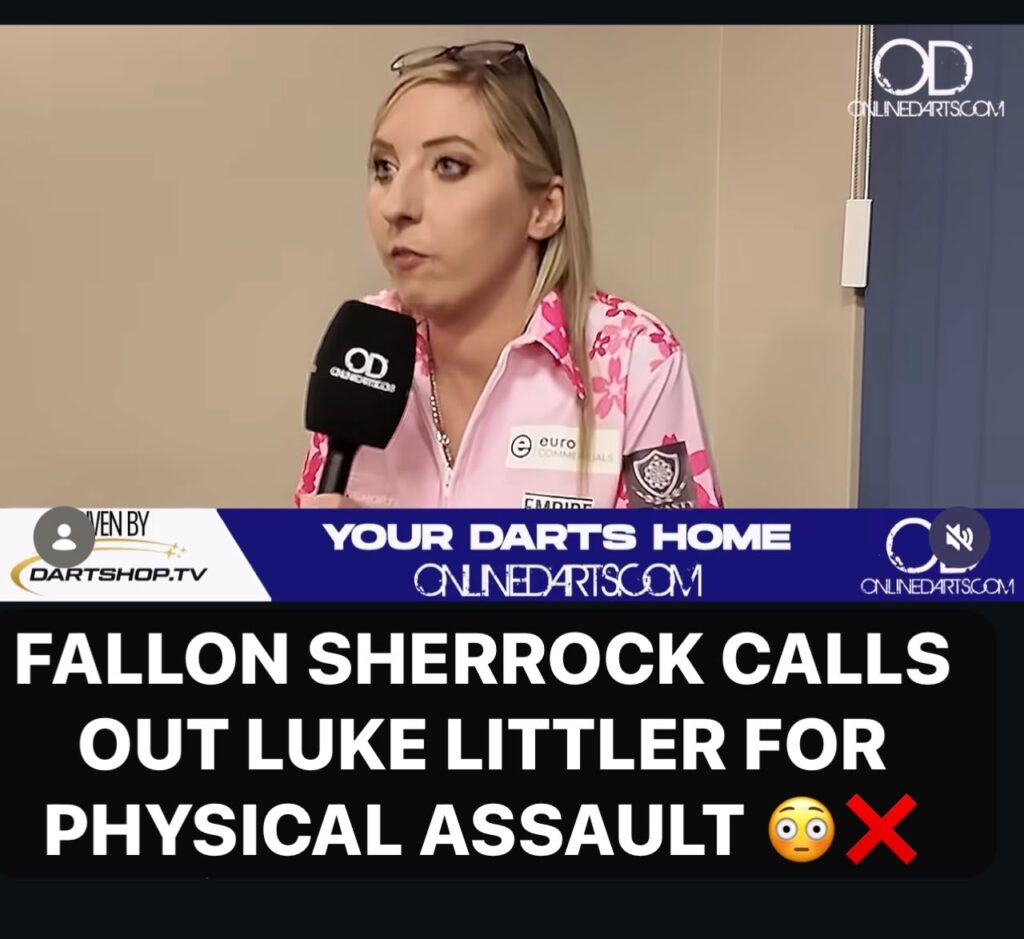
TENSION In Darts World as Fallon Sherrock Publicly Calls Out Luke Littler for Physical Assault/Violation . Full Details Below ⬇️
The darts world is no stranger to heated rivalries, emotional exchanges and headlines that spark intense debate. But when two of the sport’s most recognisable names are mentioned in the same controversy, fans naturally want answers.
The names Fallon Sherrock and Luke Littler carry enormous weight in modern darts. Sherrock made history with her groundbreaking performances on the sport’s biggest stage, while Littler has become one of the most closely watched young talents in professional darts. Their growing profiles have made them familiar names to fans far beyond the traditional darts community.
Now, a headline alleging that Sherrock has publicly called out Littler over physical assault or a violation raises serious questions. What supposedly happened? Has either player made a public statement? Is there an official investigation, or is the story being circulated without reliable confirmation?
These are important questions, and they deserve more than speculation.
As of 19 October 2026, I could not verify a credible report confirming that Fallon Sherrock publicly accused Luke Littler of physical assault or a violation. No such accusation should be treated as established fact without a reliable source, a verifiable statement or an official record.
Nevertheless, the broader issues surrounding public accusations, professional rivalries and accountability in sport deserve careful examination.
A SPORT WHERE EVERY MOMENT CAN BECOME A HEADLINE
Professional darts has evolved into a major entertainment spectacle. Packed arenas, passionate supporters, televised matches and the growth of online sports coverage have transformed the experience for players and spectators alike.
A dramatic checkout can dominate the evening. A frustrated gesture can generate thousands of comments. A disagreement between competitors can become the subject of debate long after the final dart has landed.
This environment creates opportunities for the sport to attract new audiences, but it also creates challenges.
When a headline suggests serious misconduct involving two high-profile players, the story can spread rapidly before anyone establishes what happened. Short clips may circulate without context, while social-media posts can turn speculation into apparent certainty.
That is why the distinction between a confirmed report and an unverified allegation matters.
A story involving physical assault is not simply another sporting disagreement. It concerns conduct that could have serious personal, professional and legal consequences.
Before drawing conclusions about either player, readers need to know whether an incident occurred, what evidence exists and whether the individuals involved have addressed the matter.
FALLON SHERROCK: A PLAYER WHO CHANGED THE CONVERSATION
Fallon Sherrock is one of the most recognisable figures in women’s darts.
Her historic performances at the PDC World Darts Championship in 2019 and 2020 brought her international attention. She defeated Ted Evetts and Mensur Suljović, becoming the first woman to win a match at the PDC World Championship.
Those victories were significant because they challenged longstanding expectations about women’s participation and success in elite darts.
Sherrock became known as the “Queen of the Palace”, a nickname associated with her remarkable run at Alexandra Palace. Her achievements helped introduce the sport to new audiences and inspired conversations about opportunity, representation and competitive excellence.
Her career has also included major performances on the women’s circuit. In July 2026, she reached the final of the Women’s World Matchplay, losing narrowly to Beau Greaves in a last-leg decider. In August, she won a Women’s Series title, demonstrating her continuing competitiveness.
These achievements are independently documented in darts coverage, including reporting by Sky Sports.
Sherrock’s public profile means that any genuine statement she makes about professional conduct would attract considerable attention. However, her reputation and previous achievements cannot be used as evidence that she made a particular accusation.
For a story of this nature, the essential question remains whether an authentic statement exists and what it actually says.
LUKE LITTLER: THE PRESSURE OF BEING A GLOBAL DARTS STAR
Luke Littler’s rise has been equally extraordinary.
His breakthrough at the 2024 PDC World Darts Championship established him as one of the sport’s biggest emerging stars. His subsequent success has brought championship victories, international attention and enormous public interest.
Littler’s youth and achievements have made him a prominent figure in a sport where experienced professionals traditionally dominated the spotlight.
With that visibility comes scrutiny. His performances, reactions to crowds and exchanges with opponents frequently attract attention from supporters and journalists.
In September 2026, reports also focused on his frustration with hostile crowd behaviour at events in the Netherlands. Such stories demonstrate how quickly a sporting moment can develop into a wider discussion about player treatment, crowd conduct and the pressures of professional competition.
But public scrutiny must remain evidence-based.
Criticism of a player’s behaviour is different from accusing that player of physical violence. The latter requires substantially more care, reliable documentation and an opportunity for the relevant facts to be established.
Littler should not be portrayed as having committed an act of assault merely because a sensational headline uses that language.
WHAT IS ACTUALLY KNOWN ABOUT THE ALLEGED CONTROVERSY?
The headline circulating for this proposed article suggests that Sherrock publicly called out Littler over physical assault or a violation.
However, the crucial details remain unverified.
There is no confirmed incident available here that establishes when the alleged event occurred, where it supposedly happened, what conduct is being described or whether Sherrock herself made the statement.
There is also no verified quotation that can responsibly be attributed to either player in connection with such an allegation.
Those gaps matter.
A reliable report should establish the original source of the claim. If the story began with a social-media post, readers should be able to see the original post and confirm that the account genuinely belongs to the person named. If it originated in an interview, the publication, recording or transcript should be available.
If an official body became involved, any publicly available statement should be distinguished from rumours about an investigation.
Without those details, it would be misleading to construct a narrative describing a confrontation, a physical incident, an emotional response or a subsequent disciplinary process as though those events had been confirmed.
The responsible conclusion is not that an incident definitely did or did not happen. It is that the specific allegation has not been substantiated by the information currently available.
WHY THE WORDS “PHYSICAL ASSAULT” REQUIRE CARE
In sports journalism, terminology can shape public perception before readers reach the end of an article.
Words such as “argument”, “confrontation”, “misconduct”, “assault” and “violation” do not mean the same thing.
A verbal disagreement between players may constitute a sporting dispute. An alleged breach of tournament rules may require disciplinary review. Physical assault is a substantially more serious allegation and should not be used casually to describe an event whose nature has not been established.
Even when an accusation is genuine, reporting must distinguish between an allegation, evidence supporting it, a formal finding and any subsequent appeal.
For example, if a player makes a public allegation, an accurate report can explain that the player made the allegation without automatically presenting the alleged conduct as proven.
If the other individual responds, that response should be represented fairly. If an investigation is announced, the article should explain what the investigating body has actually confirmed rather than speculate about the outcome.
These distinctions protect the integrity of sports coverage and help readers understand the status of a story.
They also matter for the people involved, whose reputations can be affected by a headline that spreads faster than the underlying evidence.
THE ROLE OF THE PROFESSIONAL DARTS AUTHORITIES
If a genuine incident involving physical misconduct occurred at a professional darts event, the appropriate response would depend on the circumstances, the available evidence and the relevant rules.
Tournament organisers and the sport’s governing or disciplinary bodies may have procedures for addressing complaints, player conduct and breaches of regulations.
A proper review could involve witness accounts, event footage, statements from the individuals involved and any other relevant material.
However, it would be inappropriate to suggest that such a process has begun in this particular case without confirmation.
It would be equally inappropriate to invent sanctions, suspensions, fines or disciplinary hearings to make the story more dramatic.
If an official statement becomes available, its exact scope matters. A statement confirming that a complaint was received would not necessarily establish that the alleged conduct occurred. An investigation would not, by itself, constitute a finding of guilt.
Readers should therefore look for primary statements and credible reporting rather than rely on anonymous claims or screenshots without a verifiable origin.
HOW SOCIAL MEDIA CAN TURN A CLAIM INTO A MAJOR STORY
Modern sports controversies often begin with a post, a short video or a headline shared across multiple platforms.
Once a claim attracts attention, users may repeat it without checking its source. Other accounts may add interpretations, alleged quotations or details that were never part of the original report.
The result can be a story that appears increasingly convincing simply because it has been repeated so many times.
High-profile athletes are particularly vulnerable to this cycle. Their names attract clicks, and emotionally charged language encourages immediate reactions.
A headline that includes a celebrated player, a rising superstar and an allegation of physical violence is likely to generate curiosity. But attention is not evidence.
Readers can help prevent misinformation from spreading by asking several basic questions:
- Who first made the claim?
- Is there an original statement or recording?
- Has a credible sports publication independently reported the incident?
- Are the words attributed to the player presented in their original context?
- Has the other person responded, and is that response authentic?
- Is the article reporting a confirmed fact or merely repeating speculation?
These questions are especially important when a story could cause lasting reputational harm.
WHAT WOULD A PUBLIC STATEMENT FROM SHERROCK MEAN?
If Sherrock were to make a verified public statement concerning inappropriate conduct, the content and context would be essential to understanding its significance.
Readers would need to know exactly what she said, what circumstances prompted the statement and whether she was describing a firsthand experience, responding to another report or discussing a broader issue.
A statement about disrespect, an argument or a breach of professional boundaries should not automatically be transformed into an accusation of physical assault.
Likewise, a genuine allegation of violence should not be minimised as ordinary sporting tension.
Both possibilities require accurate reporting.
If Sherrock has made a statement, the strongest article would quote her accurately, explain the relevant circumstances and distinguish her account from independently established facts. It would also avoid suggesting that a response from Littler had been issued unless such a response could be verified.
Without an authentic statement, attributing dramatic words or emotions to Sherrock would misrepresent her position.
WHAT ABOUT LITTLER’S RESPONSE?
Any serious report should also consider whether Littler has addressed the specific allegation.
A verified response could help establish whether he has acknowledged an incident, disputed an account, declined to comment or offered a different explanation.
Each of those circumstances would need to be reported accurately.
Silence should not automatically be interpreted as an admission, and a denial should not automatically be treated as proof that an allegation is false.
Where appropriate, a journalist should seek comment from the individual concerned or their representative and clearly explain if no response has been received by publication time.
In the absence of a verified allegation, however, it would be unfair to demand a response to a claim whose source and substance have not been established.
The objective should be to clarify the facts, not manufacture a public confrontation.
THE WIDER ISSUE OF RESPECT IN PROFESSIONAL SPORT
Regardless of this unverified headline, the question of respectful conduct in professional sport is important.
Darts combines intense concentration with a highly visible performance environment. Players compete under pressure, often in front of noisy crowds and television audiences. Emotional reactions can occur, and disagreements may arise.
That reality does not excuse intimidation, harassment or physical misconduct when such behaviour is established.
Professional standards should apply consistently, regardless of a player’s ranking, popularity, age, gender or commercial value to the sport.
At the same time, accountability depends on fair procedures. Allegations should be taken seriously, evidence should be examined carefully and conclusions should reflect what the evidence supports.
This balance is essential to maintaining confidence in the sport’s disciplinary systems.
It also helps ensure that legitimate complaints are not drowned out by sensational coverage and that people are not condemned on the strength of unverified claims.
WHY THIS STORY NEEDS VERIFIED DETAILS BEFORE FURTHER CONCLUSIONS
The public interest in Sherrock and Littler is understandable. Both players have contributed to the sport’s visibility, and their names attract substantial attention.
But a compelling headline cannot substitute for reporting.
To develop this particular story into a detailed, fact-based article, the missing evidence would need to include the original accusation or a credible report describing it. Ideally, that material would establish the date and circumstances of the alleged incident, the exact nature of the complaint and whether either player or a relevant authority has issued a statement.
With those details, it would be possible to examine the controversy in depth, explain the competing accounts fairly and explore any implications for professional darts.
Without them, adding supposed witnesses, private conversations, heated exchanges, official investigations or player quotations would create a fictional account about real people.
That is not a reliable way to report a potentially serious allegation.
CONCLUSION: FACTS MUST COME BEFORE THE FALLOUT
The headline suggesting that Fallon Sherrock publicly called out Luke Littler over physical assault or a violation is dramatic, but the central claim remains unverified in the sources available for this article.
Sherrock’s historic achievements and Littler’s extraordinary rise make them important figures in modern darts. Their public profiles ensure that any genuine dispute between them would attract considerable attention.
Nevertheless, neither a player’s fame nor the intensity of public interest establishes that an alleged incident occurred.
The next step is straightforward: establish the source, verify the statement, seek the relevant responses and determine what reliable evidence supports the claim.
Until that happens, the story should not be presented as a confirmed assault controversy.
In professional sport, accountability matters. So does fairness. And when an allegation could have serious consequences for two real people, responsible journalism must place verified facts ahead of sensationalism.
The darts world may be watching, but the most important question is not how explosive the headline sounds. It is what the evidence actually shows.
Editorial note: This article is a cautious, fact-based treatment of an unverified headline, not confirmation that an assault or public accusation occurred. The factual background on Sherrock’s career and recent darts events is supported by published sports coverage, including Sky Sports reporting on the 2026 Women’s World Matchplay and Sherrock’s Women’s Series victory.