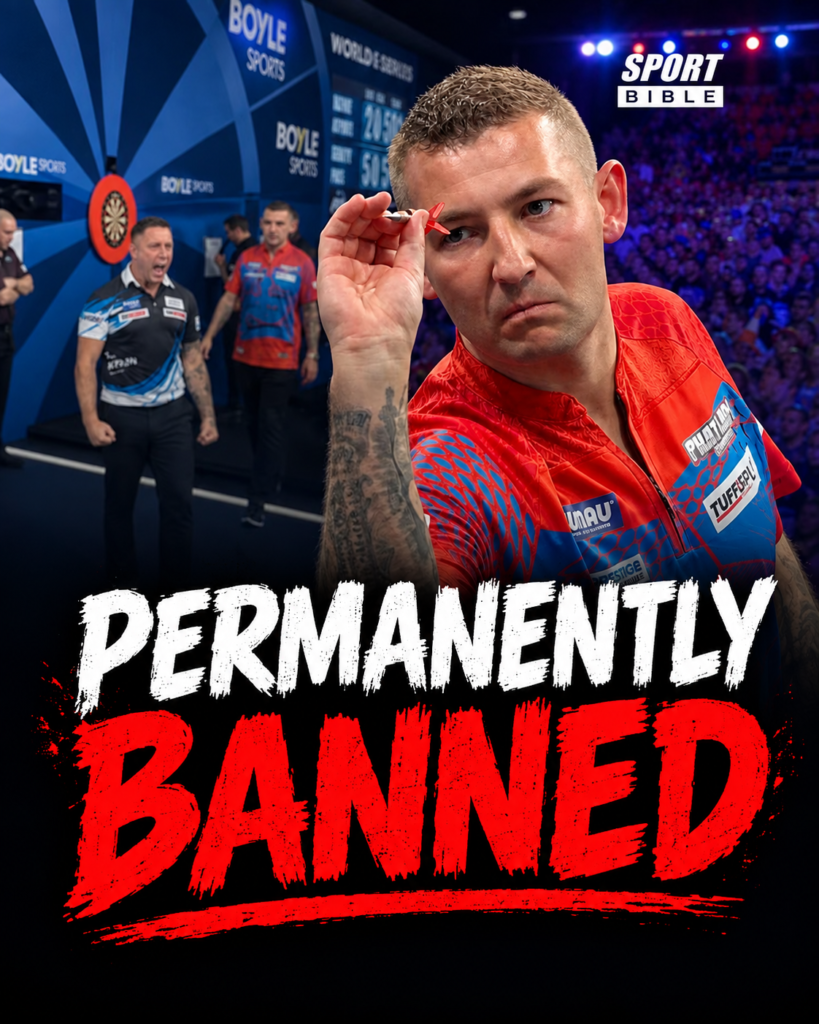
Nathan Aspinall has found himself at the centre of a major darts controversy following his dramatic World Grand Prix semi-final defeat to Gerwyn Price — but claims that the English star has been handed a lifetime ban or attacked a colleague backstage remain unsubstantiated.
The World Grand Prix was supposed to be about elite darts, major-stage pressure and another opportunity for Nathan Aspinall to challenge for a major title.
Instead, the Englishman left Leicester with his performance, behaviour and potential disciplinary consequences becoming the subject of intense discussion.
Aspinall’s tournament came to an end on Saturday night when he suffered a 5–2 semi-final defeat against Gerwyn Price.
The result itself was disappointing for “The Asp”, who had produced some excellent darts earlier in the tournament and reached the last four with genuine hopes of progressing to another major final.
But the match became increasingly tense as Aspinall struggled to contain his frustration.
An audible expletive from the 35-year-old was picked up by the television microphones during the contest, forcing broadcasters to apologise to viewers.
That moment immediately raised questions about whether the Darts Regulation Authority could punish the former World Matchplay champion.
And while speculation has since spread online about a potentially enormous punishment, including claims of a permanent or lifetime ban, the available reporting does not support those claims.
Aspinall’s World Grand Prix campaign ends in frustration
Aspinall arrived in Leicester having already demonstrated that he was capable of producing some of his best darts on the World Grand Prix stage.
The 2026 event began on September 28 and featured the world’s leading players competing for one of the sport’s biggest prizes.
Aspinall opened his campaign with a 2–1 victory over Kevin Doets before producing an impressive 3–0 victory over Luke Woodhouse in the second round.
His quarter-final performance was even more impressive.
He defeated Ryan Joyce 3–0 and produced an average of 105.15 — one of the highest averages ever recorded at the World Grand Prix.
That victory sent him into the semi-finals against former World Grand Prix champion Gerwyn Price.
The stage was set for a blockbuster.
Price had already demonstrated his own title credentials throughout the competition, while Aspinall was chasing an opportunity to return to a major final.
Instead, Price made the stronger start.
According to the Professional Darts Players Association’s event record, Price eventually defeated Aspinall 5–2 in the semi-final.
Price raced into a commanding lead, winning the opening three sets.
Aspinall eventually fought back.
The Englishman showed exactly why he remains one of the most dangerous players on the professional circuit, responding with consecutive sets to bring the match back into contention.
But the comeback ultimately fell short.
Price regained control and closed out the contest 5–2, booking his place in the World Grand Prix final.
For Aspinall, the defeat represented another frustrating near miss at a major tournament.
The moment that changed the conversation
The biggest talking point from the match, however, wasn’t simply the scoreline.
It was Aspinall’s reaction to his struggles.
As the pressure increased, his frustration became increasingly visible.
During the latter stages of the match, Aspinall missed the treble 19 and reacted angrily.
His outburst was clearly audible on the live broadcast.
The incident prompted Sky Sports commentators to apologise to viewers.
Reports subsequently suggested that Aspinall could face disciplinary action from the Darts Regulation Authority because offensive language during match play is prohibited under Rule 3.14 of the DRA Rule Book.
Importantly, however, the reporting surrounding the incident has referred to a potential fine or disciplinary action, not a lifetime ban.
That distinction is crucial.
There is currently no verified announcement showing that Aspinall has been permanently banned from professional darts.
What actually happened between Aspinall and Price?
Another major storyline from the semi-final involved Aspinall’s interactions with the crowd.
Gerwyn Price, who went on to reach the final, admitted afterwards that he had become frustrated with Aspinall’s reactions to the atmosphere inside the arena.
Price explained that he felt the crowd was actually supporting Aspinall.
The Welshman said he had spoken to Aspinall during the match and encouraged him to stop focusing on the crowd and concentrate on playing darts.
Sky Sports reported Price saying that Aspinall had been complaining about the crowd despite having significant support inside the venue.
Price described himself as a friend of Aspinall but acknowledged that he had been upset by the behaviour.
That exchange added another layer to an already tense semi-final.
But it is important not to confuse an argument, criticism or heated sporting exchange with a physical assault.
The available reports do not establish that Aspinall attacked Price or another colleague backstage.
No confirmed lifetime ban
The most serious claim circulating online is that Aspinall has been handed a lifetime ban.
At present, that claim should be treated with extreme caution.
Recent reporting concerning Aspinall’s World Grand Prix incident has consistently focused on the possibility of a fine or disciplinary review.
SportBible reported that Aspinall was expected to face a fine from the DRA after the offensive-language incident.
TalkSPORT likewise reported that he could face disciplinary action, specifically because the language appeared to breach DRA rules governing offensive language during matches.
That is a completely different situation from being permanently expelled from professional darts.
The DRA has the authority to investigate disciplinary matters and impose sanctions, but any major punishment would need to be established through an official disciplinary process.
There is currently no credible source in the reporting reviewed that confirms a lifetime ban against Aspinall.
Why the claims spread so quickly
The explosion of speculation surrounding Aspinall demonstrates just how quickly social-media headlines can move beyond the original incident.
A heated sporting moment can become a viral clip within minutes.
A player swearing on live television becomes a disciplinary story.
A disciplinary story becomes speculation about a suspension.
And before long, social-media posts can transform a potential fine into claims of a permanent ban.
That appears to be what has happened here.
The phrase “PERMANENTLY BANNED” is certainly attention-grabbing.
It creates an immediate sense of drama and encourages readers to click.
But the evidence currently available does not establish that such a punishment has been imposed on Aspinall.
The verified story is already dramatic enough.
A former major champion reached the semi-final of a major tournament, suffered a heavy defeat after struggling to find his best form, became visibly frustrated, swore during the match and potentially put himself in line for disciplinary action.
There is no need to add an unverified physical attack or lifetime ban to make the story significant.
Aspinall had plenty to be proud of
Despite the controversy surrounding the semi-final, Aspinall’s overall World Grand Prix campaign was far from a disaster.
In fact, the tournament produced several reasons for optimism.
His 105.15 average against Ryan Joyce was one of the standout performances of his week.
The victory demonstrated that his ability to perform on the biggest stages remains intact.
His route to the semi-final also showed consistency.
After defeating Doets in his opening match, he swept Woodhouse 3–0 before producing another convincing victory over Joyce.
That run placed him among the final four players competing for one of the most prestigious titles on the calendar.
Aspinall himself later reflected positively on his tournament despite admitting that the semi-final was one of his poorer performances.
DartsNews reported that Aspinall described himself as very happy with how his tournament had gone overall and highlighted the contrast between his excellent quarter-final performance and his disappointing semi-final.
That perspective is important.
One bad night does not erase an entire tournament.
The social-media backlash
Following his defeat, Aspinall also faced abuse online.
The reaction became sufficiently serious that the darts star publicly addressed people who had targeted him, his family and people close to him.
According to reports, Aspinall criticised online abusers following the World Grand Prix and insisted that the criticism had gone too far.
That development highlights another issue surrounding professional sport in the social-media era.
Players are increasingly exposed to immediate public judgment.
A missed double can become a viral clip.
An emotional reaction can be replayed thousands of times.
A frustrated expression can be interpreted as arrogance.
And a few seconds of bad behaviour can quickly overshadow an otherwise successful tournament.
Aspinall’s case is a particularly clear example.
He reached a major semi-final.
He produced one of the tournament’s best averages.
He defeated several dangerous opponents.
Yet much of the post-tournament conversation became centred on his emotional reaction during the defeat.
Gerwyn Price adds to the drama
Price’s comments after the match also ensured that the controversy would not disappear immediately.
The Welshman admitted that Aspinall’s behaviour had irritated him.
Price said he had spoken directly to his opponent during the match, telling him that the crowd was actually supporting him.
He also suggested that Aspinall was allowing himself to become distracted instead of simply concentrating on his darts.
At the same time, Price made it clear that the relationship between the two players remained friendly.
That is another important piece of context.
There was tension.
There was frustration.
There was criticism.
But that does not automatically mean the players became involved in a physical confrontation.
The available evidence describes a heated sporting environment rather than the violent backstage incident being claimed in some sensational online versions of the story.
The DRA’s role
The Darts Regulation Authority exists to regulate disciplinary matters within professional darts.
Its rules cover player conduct both on and away from the stage.
Offensive language during matches can attract punishment, depending on the circumstances.
Aspinall’s televised outburst therefore has a legitimate disciplinary dimension.
But disciplinary proceedings are not the same thing as an automatic lifetime ban.
The severity of any punishment depends on the nature of the alleged breach, the circumstances surrounding it and the relevant regulations.
Recent DRA disciplinary information also demonstrates that sanctions can take different forms.
A published summary of disciplinary cases from 2023 through June 2026 included fines, warnings and suspended bans involving several prominent players.
For example, Cameron Menzies received a £2,500 fine and a four-month suspended ban following an incident at the World Darts Championship.
Raymond van Barneveld was also given a three-month suspended ban and a £3,000 fine for inappropriate behaviour and offensive language at a Players Championship event.
Those examples show that the disciplinary system can impose meaningful sanctions without automatically ending a player’s career.
Could Aspinall still be punished?
Yes.
That remains a realistic possibility.
The reports following the World Grand Prix semi-final strongly suggest that Aspinall could be investigated or sanctioned over his language.
The exact punishment, if any, would depend on the disciplinary process.
A fine would be considerably more consistent with the reporting currently available than a lifetime ban.
That does not mean Aspinall is guaranteed to escape punishment.
Professional darts has clear conduct standards, particularly during televised matches.
Players are expected to understand that microphones are positioned around the stage and that millions of viewers can potentially hear their reactions.
Emotions are naturally part of competitive sport.
But professional players are still expected to control their behaviour.
A disappointing ending to a promising week
There is no question that Aspinall will be disappointed with how his World Grand Prix campaign ended.
After producing a stunning performance against Joyce, he entered the semi-final with genuine momentum.
Instead, he fell behind 3–0.
Although he managed to fight his way back into the match, Price ultimately proved too strong.
For a player of Aspinall’s ability, another major semi-final exit will naturally hurt.
But it is also evidence that he remains capable of competing deep into major tournaments.
The challenge now is turning those semi-final appearances into another major title.
His most recent run provides plenty of encouragement.
His performance against Joyce showed what he can produce.
His fightback against Price showed resilience.
His frustration in the final stages showed just how much the result mattered to him.
The next step will be ensuring that those emotions become fuel rather than a distraction.
The real headline
For now, the real headline is not that Nathan Aspinall has been permanently banned.
It is that Nathan Aspinall could face disciplinary action after an emotional and controversial World Grand Prix semi-final defeat.
That is supported by the reporting.
The lifetime-ban claim is not.
Neither is the claim that Aspinall physically attacked a colleague backstage.
Those allegations should not be presented as established facts without an official announcement or credible evidence.
The World Grand Prix semi-final was certainly heated.
Aspinall lost 5–2.
He swore during the match.
The broadcasters apologised.
Gerwyn Price criticised aspects of his behaviour.
The DRA may consider disciplinary action.
But none of that currently amounts to a confirmed lifetime ban.
What happens next?
The attention will now turn to the DRA and whether any formal action is announced.
If the governing authority decides to investigate the incident, the eventual decision will provide clarity over whether Aspinall receives a fine, warning or another sanction.
Until then, speculation will continue.
For Aspinall, the best response may simply be to move forward.
He has already demonstrated that he can produce world-class darts.
His 105.15 average against Joyce was a reminder of exactly what he is capable of.
His World Grand Prix campaign ultimately ended one match short of the final, but it also gave him another opportunity to compete at the highest level.
The controversy will undoubtedly be discussed for some time.
But the 35-year-old’s career is not, based on the evidence currently available, over.
There has been no confirmed lifetime ban.
There has been no verified report of a backstage physical attack.
What there has been is a highly emotional semi-final, an on-stage outburst, criticism from an opponent and the possibility of disciplinary consequences.
And that distinction matters.
Final verdict
Nathan Aspinall is facing scrutiny — not a confirmed lifetime ban.
The Englishman endured a frustrating 5–2 defeat to Gerwyn Price in the World Grand Prix semi-final after initially falling three sets behind and briefly fighting his way back into the contest.
His frustration boiled over when he used offensive language during the match, an incident that could result in DRA punishment.
Price also admitted that he was annoyed by Aspinall’s reactions to the crowd and said he had spoken to him during the match.
But as of the latest credible reports, there is no confirmed lifetime ban and no verified evidence of a violent backstage attack.
The darts world will therefore be watching closely for any official DRA announcement.
Until one arrives, claims of a permanent ban should be treated as unverified speculation rather than fact.