
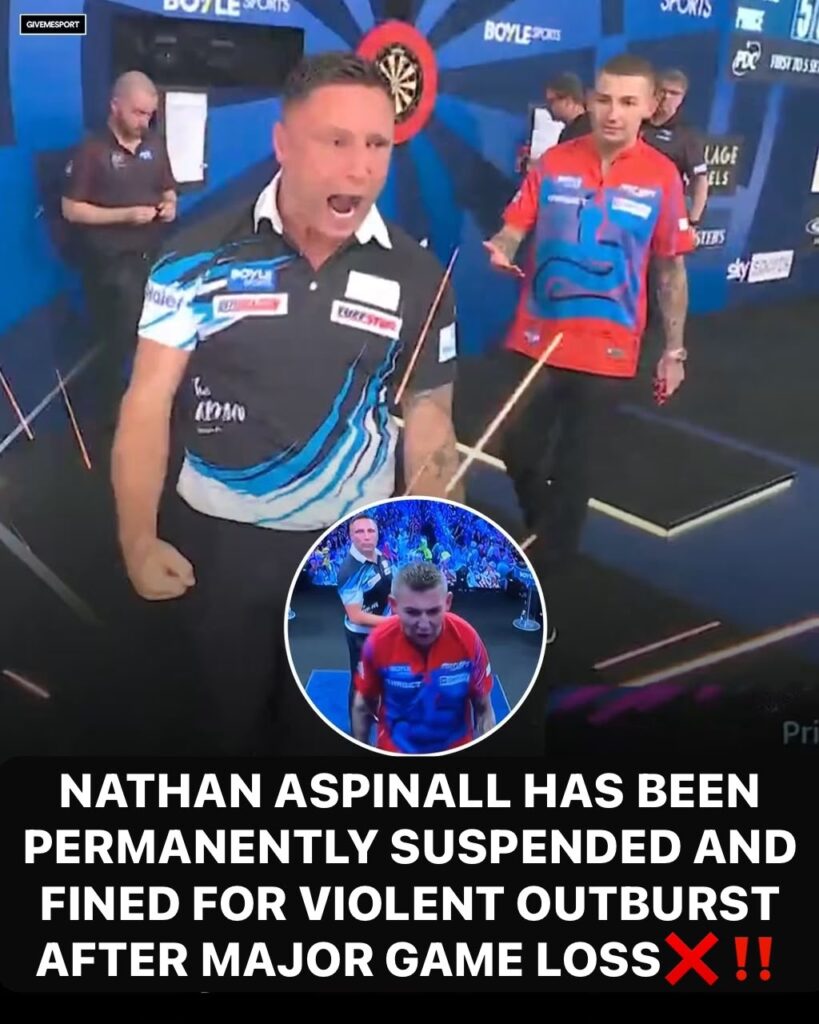
TENSION In Darts World As Nathan Aspinall Faces Permanent Ban For Violent Outburst After Major Game Loss. Full Details Below
Nathan Aspinall’s emotional World Grand Prix exit has sparked fresh tension in the darts world after the Englishman was caught on live television using offensive language during his semi-final defeat to Gerwyn Price.
The dramatic incident has raised questions about whether “The Asp” could now face disciplinary action from the Darts Regulation Authority, with the player already under scrutiny following a heated night in Leicester.
However, despite some online claims suggesting that Aspinall could be facing a permanent ban, there is currently no evidence that such a punishment has been imposed or announced. The confirmed issue concerns his use of offensive language during the match, something specifically covered by DRA regulations.
The controversy came during Aspinall’s World Grand Prix semi-final against former champion Gerwyn Price at the Mattioli Arena on Saturday, October 3.
What had promised to be one of the biggest nights of Aspinall’s tournament instead ended in frustration as Price secured a 5-2 victory and booked his place in the final.
Aspinall’s disappointment was visible throughout the contest, but the moment that generated the most attention came when he missed the treble 19 bed twice and reacted angrily.
His words were picked up clearly by the microphones, forcing Sky Sports commentators to apologise to viewers for the language.
Under Rule 3.14 of the DRA Rule Book, players are prohibited from using or mouthing offensive language during match play. That means Aspinall could potentially face disciplinary consequences, although the exact punishment would depend on the circumstances.
And the controversy did not stop there.
Following the match, Price openly admitted that he had been frustrated with Aspinall’s behaviour during the contest and had even spoken to his fellow professional while the match was still taking place.
The Welshman claimed that Aspinall was becoming too focused on the crowd and urged him to stop “performing” and concentrate on playing darts.
The comments added another layer to an already tense evening.
Aspinall’s night turns sour
There had been plenty of reason for Aspinall to feel confident heading into the semi-final.
The Stockport-born star had produced an outstanding performance in his quarter-final victory over Ryan Joyce, averaging 105.15 in a dominant 3-0 win.
That performance was particularly impressive because it ranked among the highest averages ever recorded at the World Grand Prix.
Aspinall therefore arrived at the semi-final believing he had a genuine opportunity to reach another major final.
Instead, he struggled to reproduce that form against Price.
The match quickly became difficult for the Englishman.
Price established control early, putting Aspinall under increasing pressure and moving into a commanding 3-0 lead.
For Aspinall, frustration began to build.
The match was not simply slipping away from him; he was struggling to produce the level of darts that had carried him through the earlier rounds.
His reactions became increasingly noticeable.
The pressure eventually boiled over when he missed consecutive attempts at treble 19.
Aspinall reacted angrily, with the resulting expletive being picked up by the television microphones.
The commentators immediately acknowledged the language and apologised to viewers.
Although swearing in the heat of competition is hardly unusual in professional sport, darts has specific regulations governing player conduct, meaning an incident caught clearly on live television can attract the attention of the DRA.
That is why the incident has become more than simply an emotional moment.
Could Aspinall really be banned?
This is where the story needs to be separated from social-media speculation.
There is currently no confirmed permanent ban against Nathan Aspinall.
Reports following the incident have indicated that he could face a fine or other disciplinary action because of the language he used during the match.
SportBible reported that Aspinall was expected to receive a fine, while talkSPORT reported that the DRA was likely to take an interest in the incident.
That is very different from a lifetime or permanent suspension.
The DRA has previously punished players for inappropriate conduct, offensive language and aggressive behaviour, but sanctions vary depending on the circumstances of each case.
The regulatory body’s recently published disciplinary records demonstrate that consequences can range from formal warnings and fines to suspensions in more serious cases.
For example, Nathan Aspinall himself appeared in the DRA case list for an earlier incident involving offensive language at a Players Championship event. He received a £750 fine and a formal warning.
That previous disciplinary history makes the latest incident particularly interesting.
But it still does not mean a permanent ban is inevitable.
The DRA rule at the centre of the controversy
The key regulation is Rule 3.14.
Players are prohibited from using or mouthing offensive language during match play.
The purpose of such rules is straightforward.
Professional darts is now a major televised sport watched by audiences around the world, including younger viewers. Players are therefore expected to maintain certain standards of behaviour while competing on stage.
The difficulty is that darts is an intensely emotional sport.
Players stand just a few metres from the board while competing under enormous pressure. A single missed double can cost thousands of pounds, ranking points, a title or an opportunity to reach a major final.
That pressure can produce raw reactions.
The challenge for players is controlling those reactions.
Aspinall’s situation demonstrates exactly why the DRA rule exists.
The incident was not hidden backstage or captured privately. It happened during a televised major semi-final, with microphones close enough to pick up his words.
Consequently, the moment became part of the broadcast almost instantly.
Gerwyn Price adds fuel to the fire
If Aspinall’s outburst had been the only talking point, the controversy might have ended there.
But Gerwyn Price had his own frustrations.
After completing his 5-2 victory, the Welshman spoke openly about Aspinall’s behaviour.
Price suggested that Aspinall had been complaining about the crowd despite the crowd appearing to support him.
According to Price, he told Aspinall during the match that the crowd was actually on his side and encouraged him to focus on the darts instead.
Price described himself as being upset with the situation.
He also said he was frustrated with much of the match.
The comments were notable because Price and Aspinall are known to have a good relationship away from competition.
Price himself made that clear.
He explained that he was good friends with Aspinall but believed his opponent needed to let his darts do the talking.
The exchange therefore appeared less like a personal feud and more like two highly competitive players becoming frustrated during a major semi-final.
Still, Price’s comments gave the story another dimension.
It was no longer simply about one player swearing after missing a target.
It had become a discussion about behaviour, crowd interaction, competitive pressure and the standards expected from elite players.
A dramatic comeback that never arrived
Aspinall did briefly give himself hope.
After falling three sets behind, the Englishman managed to win two consecutive sets.
Suddenly, the match appeared capable of turning into one of the tournament’s great comebacks.
The crowd remained engaged, and Aspinall had an opportunity to put Price under genuine pressure.
But Price regained his composure.
The Welshman eventually closed out the contest 5-2.
For Aspinall, it was a painful conclusion to a tournament that had otherwise contained plenty of positives.
He had reached another major semi-final and produced one of the best stage performances of his recent career against Joyce.
Yet the manner of his defeat meant the conversation immediately shifted from his darts to his behaviour.
That is the brutal reality of professional sport.
One moment can overshadow an entire tournament.
Aspinall breaks his silence
Rather than allowing the controversy to define his tournament, Aspinall later reflected positively on his overall campaign.
On October 5, he addressed the World Grand Prix on social media.
The Englishman acknowledged the contrast between his outstanding performance against Joyce and his difficult semi-final against Price.
He described the tournament as containing “so many positives” and said he was happy to have reached another major semi-final.
That response is significant.
Rather than suggesting that the defeat had destroyed his confidence, Aspinall appeared determined to look at the bigger picture.
He also congratulated Luke Humphries on winning the World Grand Prix after Humphries produced a remarkable comeback against Price in the final.
But the message did not end there.
Aspinall also addressed the abuse he said he and his family had received online following the semi-final.
He strongly criticised people who had targeted him and those close to him.
That reaction highlights another issue increasingly affecting professional athletes: the immediate backlash that follows controversial moments on social media.
A player can walk off stage after a disappointing performance and, within minutes, face thousands of comments from strangers.
For an athlete already dealing with the emotional disappointment of losing a major semi-final, that can create an entirely different kind of pressure.
The difference between emotion and misconduct
One of the biggest questions surrounding Aspinall’s situation is where the line should be drawn between natural sporting emotion and unacceptable behaviour.
Darts players are not robots.
They miss doubles.
They lose matches.
They throw away leads.
They experience frustration.
They sometimes shout.
They sometimes celebrate aggressively.
They sometimes show visible disappointment.
That emotional element is part of what makes darts compelling.
But professional sport also requires boundaries.
The DRA’s job is not to eliminate emotion from darts. It is to ensure that emotion does not cross into conduct that breaches the sport’s rules.
That distinction matters in Aspinall’s case.
The available reporting points toward a disciplinary issue surrounding offensive language rather than an incident involving physical violence, an attack on another player or behaviour warranting a permanent suspension.
That is why claims of a lifetime ban currently appear unsupported.
Darts has seen serious disciplinary cases before
The sport has previously witnessed considerably more serious incidents.
The DRA’s published case list includes cases involving aggressive behaviour, threatening conduct, inappropriate behaviour and other breaches.
Cameron Menzies, for example, was given a four-month suspension and a £2,500 fine after repeatedly punching the underside of a drinks table following his World Championship defeat to Charlie Manby. His actions resulted in blood on his knuckles.
Other players have also received fines or suspensions for different forms of misconduct.
Gary Anderson was fined £3,000, with £1,000 suspended, following aggressive and abusive behaviour backstage after his 2025 World Matchplay defeat to Stephen Bunting.
Raymond van Barneveld received a three-month suspension, suspended for 12 months, together with a £3,000 fine over inappropriate behaviour and offensive language.
These cases demonstrate that the DRA is prepared to impose meaningful sanctions when it considers player conduct serious enough.
But they also show that disciplinary outcomes are case-specific.
There is no indication from the currently available reporting that Aspinall has been placed in the same disciplinary category as players who have received lengthy suspensions.
Why the permanent-ban rumours spread
So how did the idea of a permanent ban emerge?
The answer is likely the combination of a dramatic headline, social-media reaction and the fact that the DRA has the power to discipline players.
Once news broke that Aspinall could face disciplinary action, online discussion quickly escalated.
Words such as “ban”, “suspension” and “DRA investigation” can easily become exaggerated when repeated across social media.
A potential fine becomes a suspension.
A possible suspension becomes a ban.
And before long, a routine disciplinary investigation can be transformed into a claim that a player is facing the end of his career.
That does not appear to be the reality here.
At the time of writing, there is no confirmed announcement of a permanent ban against Aspinall.
The most credible reports have instead focused on the possibility of a fine or disciplinary response for his offensive language.
A difficult night for “The Asp”
For Aspinall, the timing is particularly unfortunate.
He was attempting to reach his first major final in three years.
The former World Matchplay champion had fought his way through a competitive field and produced one of the tournament’s strongest performances against Joyce.
His semi-final against Price was therefore supposed to be another major opportunity.
Instead, it became a night of frustration.
His darts deserted him at crucial moments.
His opponent gained control.
The crowd became part of the discussion.
His emotions boiled over.
And his words were captured live on television.
Yet none of that erases the fact that reaching the semi-final remains a significant achievement.
Aspinall himself appears to recognise that.
His social-media message suggested that he intends to take the positives from the tournament and return to competition after spending time with his family.
What happens next?
The next significant development will be whether the DRA formally announces disciplinary action.
If the governing body decides to pursue the matter, Aspinall could potentially receive a fine or another sanction depending on its assessment.
The previous disciplinary records show that the DRA considers factors including the nature of the conduct and the circumstances surrounding an incident when determining penalties.
For now, however, there is no confirmed permanent suspension.
That distinction should remain clear.
The situation is serious enough to attract attention because the language was used during a televised major event, but it should not be transformed into something that has not actually happened.
Price moves on
While Aspinall dealt with the aftermath of his defeat, Price moved forward to the World Grand Prix final.
The Welshman was able to put the controversy behind him and prepare for another major opportunity.
Ironically, Price himself would eventually experience one of the most dramatic twists of the tournament.
After establishing a 3-0 lead in the final, he was beaten 6-4 by Luke Humphries, who completed an extraordinary comeback to lift the World Grand Prix title.
That result meant the tournament ultimately ended with Humphries celebrating and Price left to reflect on another major final defeat.
For Aspinall, meanwhile, the tournament ended one round earlier.
The bigger picture for darts
The controversy surrounding Aspinall is another reminder of how much professional darts has changed.
Darts is no longer simply a pub game played away from the spotlight.
Major tournaments are broadcast internationally.
Players are followed by millions of fans.
Microphones capture almost every reaction.
Social media provides immediate commentary.
And sponsors, broadcasters and governing bodies increasingly expect athletes to maintain professional standards.
That environment creates a difficult balance.
Fans want authenticity.
They want emotion.
They want players to show personality.
But governing bodies also want players to remember that their behaviour is being watched by a global audience.
Aspinall’s incident sits directly in that grey area.
His frustration was genuine.
His reaction was emotional.
But because it happened during live television coverage, it also became a regulatory matter.
No permanent ban — but a warning nonetheless
The most accurate conclusion at this stage is therefore much less dramatic than some of the online headlines suggest.
Nathan Aspinall is not confirmed to be facing a permanent ban.
What he is facing is the possibility of disciplinary action after using offensive language during his World Grand Prix semi-final defeat to Gerwyn Price.
That could mean a fine or another sanction, depending on the DRA’s assessment.
The incident is nevertheless significant because Aspinall has already previously received a fine and formal warning for offensive language, meaning another disciplinary issue could attract additional scrutiny.
For now, the biggest punishment remains the sporting one.
Aspinall lost the semi-final.
He missed another opportunity to reach a major final.
And a tournament in which he had produced one of his strongest performances ended with his emotions becoming one of the biggest talking points.
Whether the DRA decides to add a financial or disciplinary consequence remains to be seen.
But one thing is already certain: the incident has put “The Asp” firmly back under the spotlight.
Final verdict
Nathan Aspinall’s World Grand Prix campaign was a mixture of brilliance, frustration and controversy.
His 105.15 average against Ryan Joyce demonstrated exactly why he remains one of the most dangerous players on the professional circuit.
His semi-final defeat to Gerwyn Price demonstrated the other side of elite competition — the emotional pressure, missed opportunities and frustration that can accompany a major loss.
His live-TV outburst has now placed him under potential DRA scrutiny.
Gerwyn Price’s post-match criticism added fuel to the story.
And Aspinall’s subsequent response showed that, despite the disappointment, he remains determined to take the positives from his tournament.
But claims that he has been permanently banned should be treated with caution.
There is currently no confirmed evidence of a lifetime suspension.
The immediate issue is much simpler: Aspinall could face disciplinary action for offensive language during the match.
Whether that results in a fine, formal warning or another sanction will ultimately be determined by the relevant authorities.
For now, the darts world waits.
And after an already explosive World Grand Prix semi-final, the next chapter of the Nathan Aspinall controversy could be decided away from the oche — in the hands of the Darts Regulation Authority.