
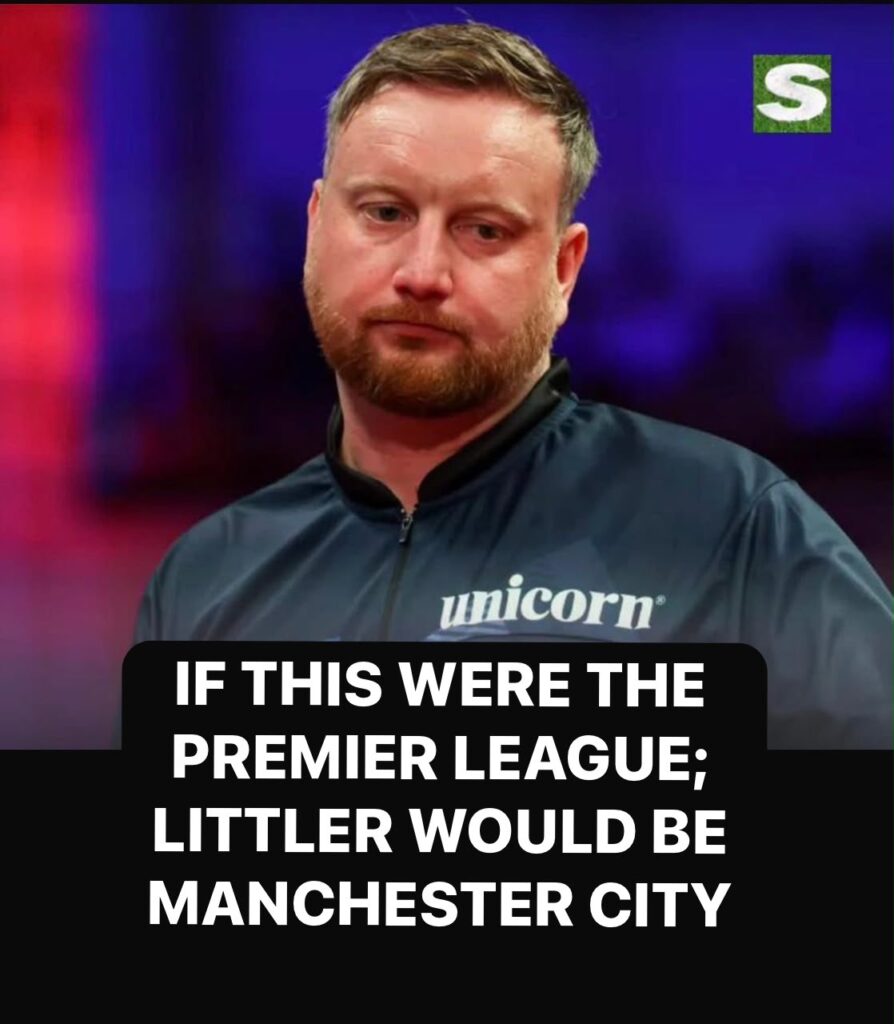
In the high-stakes world of professional darts, few names have generated as much buzz recently as Luke Littler. But while the teenage sensation continues to dazzle crowds with his scoring power, fellow professional Cameron Menzies has sparked a heated debate by claiming that the sport’s rising star is receiving preferential treatment.
Menzies, the outspoken Scottish dart player, took to social media and subsequent interviews to voice his frustration regarding what he perceives as “ignored offenses” committed by Littler during matches. In a scathing comparison, Menzies likened the 19 year-old’s treatment by officials and the media to that of Manchester City Football Club—arguing that both entities operate under a different set of rules due to their overwhelming success and popularity.
“The Manchester City of Darts”
“It’s becoming the Manchester City of darts,” Menzies stated in a candid post-match interview. “When you’re winning everything and the crowd loves you, it seems like the rules bend a little bit. Luke is a fantastic talent, nobody is denying that, but there are things happening on the oche that would be called out if it were me or another player.”
Menzies’ comparison to Manchester City—a club that has faced relentless scrutiny over financial fair play allegations while simultaneously dominating the Premier League—was a pointed one. He suggested that Littler’s meteoric rise has created an aura of invincibility, leading to a blind eye being turned toward minor breaches of etiquette or slow play that other players would be penalized for.
“There’s a lot of hype, a lot of money, and a lot of eyes on him,” Menzies added. “It feels like the officials are scared to ruffle the feathers of the golden goose.”
The Specifics of the Dispute
While Menzies did not cite a specific incident from a recent match, his comments appear to reference Littler’s on-stage demeanor and pace of play. Critics have occasionally pointed out that Littler, despite his youth, often engages in gamesmanship—taking extra time at the oche or interacting with the crowd in ways that could be deemed distracting.
Menzies argues that if a lower-ranked player were to exhibit the same behavior, they would face immediate warnings from the referee. Instead, he claims, Littler is celebrated for his “character” and “confidence.”
A Divisive Reaction
The darts community has reacted with a mix of agreement and fierce defense of the teenage star.
Supporters of Menzies argue that the PDC (Professional Darts Corporation) has a vested interest in protecting Littler, whose drawing power has skyrocketed ticket sales and viewing figures. They point to the “Littler Effect,” a phenomenon where crowds become increasingly rowdy and biased, creating an uneven playing field.
However, critics of Menzies’ stance have accused the Scot of sour grapes. Many fans took to social media to defend Littler, noting that the teenager has handled immense pressure with grace and that his “offenses” are merely the exuberance of youth.
“Cameron sounds like a bitter rival,” one fan commented on X (formerly Twitter). “Littler is good for the game. If he takes an extra second to compose himself, that’s because he’s actually thinking about the dart, unlike half the tour.”
The Pressure of the Spotlight
Littler’s camp has yet to issue a formal response to Menzies’ comments. The young star, who has previously stated that he tries to block out the noise, remains focused on his upcoming fixtures.
However, the comparison to Manchester City raises interesting questions about the nature of dominance in sport. Just as Manchester City’s critics argue that their financial might creates an unfair advantage, Menzies suggests that Littler’s commercial might affords him a level of leniency not afforded to the journeymen of the tour.
What’s Next?
As the darts calendar progresses, all eyes will be on the referees. Will officials begin to clamp down on Littler’s perceived micro-offenses to prove they are impartial? Or will the “Littler Effect” continue to dictate the atmosphere of the sport?
For Cameron Menzies, the gauntlet has been thrown down. He has positioned himself as the voice of the traditionalist—a player who believes that talent should not exempt anyone from the rules of the game.
Whether the darts world views him as a truth-teller or a jealous rival, one thing is certain: the debate over Luke Littler’s rise is no longer just about his averages—it’s now about the politics of the oche.