
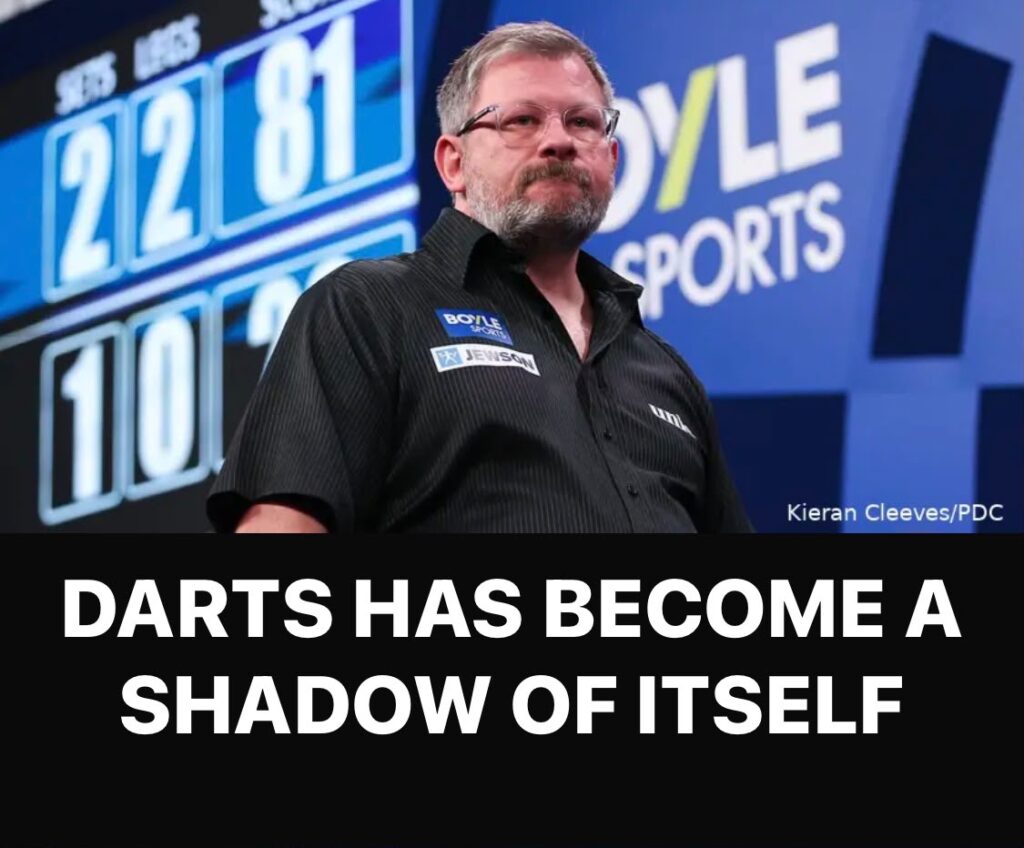
In a stunning development that has sent ripples through the professional darts world, former World Matchplay champion James Wade has hinted at a potential retirement while delivering a scathing assessment of the modern game, declaring that “darts has become a shadow of itself.”
The 40-year-old Englishman, a veteran of over two decades on the professional circuit and one of the most decorated players in PDC history, made the comments during a candid interview following his early exit from a recent ranking event. Wade, known for his quiet intensity and no-nonsense approach, did not hold back as he voiced his concerns about the direction the sport has taken.
“The Game Has Changed—and Not for the Better”
“I’ve been doing this for a long time, and I can honestly say darts has become a shadow of itself,” Wade stated, his frustration palpable. “It’s not about the sport anymore. It’s about the noise, the flash, the walk-on music, the social media clips. The actual art of throwing a dart has been lost in the circus.”
Wade, a former World Number Two and winner of multiple major titles including the World Grand Prix and the UK Open, pointed to what he perceives as a degradation of the sport’s traditions and competitive integrity. He argued that the modern PDC era has prioritized entertainment value over the purity of competition, creating an environment where showmanship trumps substance.
“When I started, you earned respect by hitting your doubles and conducting yourself properly,” Wade continued. “Now, it feels like the louder you are, the more attention you get. The crowd wants a pantomime, not a dart match. And the powers that be are happy to give it to them because it sells tickets.”
Retirement Looms
When pressed on his future in the sport, Wade was uncharacteristically reflective. The ten-time major winner admitted that the fire that once drove him to the top of the world rankings is beginning to wane.
“I’m not going to lie—I’ve thought about walking away,” he confessed. “I’ve achieved more than I ever dreamed of. I’ve won majors, I’ve been World Number Two, I’ve played in front of thousands. But when you don’t recognize the sport you fell in love with, it makes you question why you’re still putting in the hours.”
Wade’s hint at retirement comes at a pivotal moment in his career. Once a consistent fixture in the world’s top ten, he has seen his ranking slip in recent seasons as a new generation of players—many of them teenagers—has stormed onto the scene. The rise of stars like Luke Littler has shifted the sport’s spotlight, and Wade’s traditional, methodical style has often been overshadowed by the explosive scoring power of the newcomers.
A Growing Chorus of Discontent
Wade is not the first veteran to voice concerns about the modern game. His comments echo similar sentiments expressed by other established players who feel the PDC has sacrificed the sport’s dignity at the altar of commercial success. Critics argue that the relentless push for faster, louder, and more dramatic darts has alienated traditional fans and created an environment hostile to players who prefer a quieter, more focused approach.
The PDC has yet to respond to Wade’s comments, but insiders suggest that the organization is unlikely to shift its strategy. The sport’s popularity has never been higher, with record ticket sales, television viewing figures, and sponsorship deals. The “Littler Effect” has brought darts into the mainstream in a way not seen since the days of Phil Taylor and Raymond van Barneveld.
The Fans Weigh In
Reaction from the darts community has been predictably divided. Some fans praised Wade for his honesty, agreeing that the sport has lost some of its soul in the pursuit of entertainment.
“James is right,” one fan posted on social media. “I love the drama as much as anyone, but there’s a limit. It’s becoming more about the crowd than the darts. Respect to Wade for saying what a lot of the old-school players are thinking.”
Others, however, accused Wade of being out of touch, arguing that the sport must evolve to survive and that the new generation of fans—attracted by the spectacle—is essential to darts’ continued growth.
“Wade sounds like an old man yelling at clouds,” another fan commented. “The sport is more popular than ever. If he doesn’t like it, maybe it is time for him to go.”
What’s Next for Wade?
For now, James Wade remains a contracted PDC player, and he has not formally announced any retirement plans. But his comments suggest that the end may be nearer than many expected. Should he choose to walk away, he would leave behind a legacy as one of the most consistent and respected players of his generation—a two-time World Championship semi-finalist, a major winner, and a man who, for a time, was considered the most naturally gifted player on the tour.
But Wade’s final message was less about his own legacy and more about the sport he loves.
“I hope I’m wrong,” he concluded. “I hope in ten years’ time, darts is still thriving and the players are still respected for what they do on the board. But right now, I look at the game and I don’t see the sport I grew up with. I see a show. And that’s a sad thing for me.”
The Debate Rages On
As the darts world digests Wade’s explosive comments, the broader question remains: is the sport’s modernization a necessary evolution or a betrayal of its roots? For James Wade, the answer is clear. For the PDC, the fans, and the next generation of players, the debate is only just beginning.
One thing is certain—James Wade has never been afraid to speak his mind. And if this is to be his final chapter in professional darts, he is determined to go out with his voice heard.